Recent Cybersecurity Threats and Future Concerns for UAE Businesses
UAE businesses increasingly depend on Microsoft 365, cloud platforms, remote access, connected applications, employee devices, suppliers and customer-facing digital services. These technologies help organisations grow and operate more effectively, but they also increase the number of identities, devices, applications and external connections that must be protected.
The most important cybersecurity threats UAE businesses face in 2026 are not limited to highly sophisticated attacks against large organisations. They include convincing payment fraud, compromised employee accounts, exposed cloud data, vulnerable systems, ransomware disruption and supplier access that has not been reviewed properly.
The practical challenge is not to defend against every possible threat equally. Businesses need to understand which systems, accounts, data and processes matter most, identify where they are exposed and address the highest-priority gaps first.
Table of Contents
What cybersecurity threats are UAE businesses facing in 2026?
The main threats are phishing and payment fraud, ransomware, identity compromise, cloud exposure, exploitation of known vulnerabilities, third-party access and increasingly convincing AI-assisted impersonation.
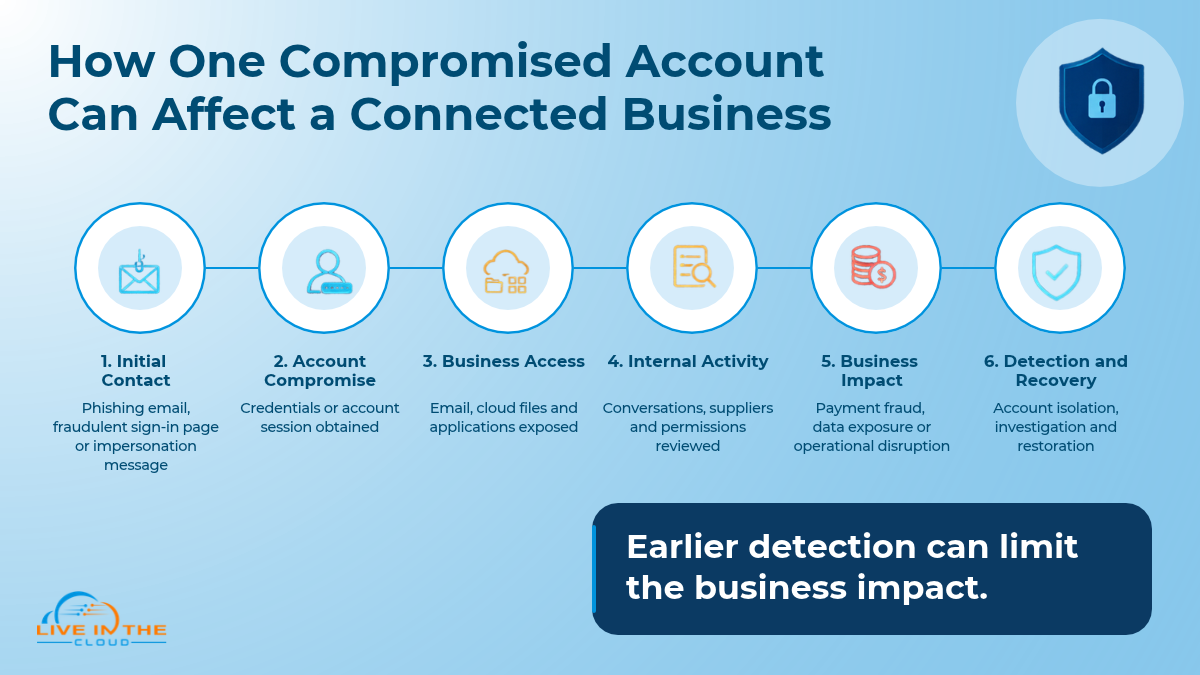
These risks are often connected. A phishing email can lead to an account compromise. That account may provide access to business applications, cloud files or payment conversations. If monitoring and recovery procedures are also weak, a single incident can develop into wider operational disruption.
| Threat | How it may reach the business | Possible business effect | Priority review |
| Phishing and business email compromise | Fraudulent or compromised email | Payment fraud, data disclosure and supplier disputes | Email controls and payment verification |
| Ransomware | Compromised device, account or remote service | Downtime, data exposure and recovery pressure | Endpoints, patching, backups and response |
| Identity compromise | Stolen credentials or excessive access | Unauthorised access to cloud data and applications | MFA, access policies and account reviews |
| Cloud exposure | Incorrect permissions or public sharing | Sensitive business information becomes accessible | Configuration, roles and sharing policies |
| Third-party access | Supplier, contractor or application connection | Indirect access to systems and data | Access ownership, expiry and monitoring |
| AI-assisted fraud | Convincing email, voice or video impersonation | Fraudulent approvals or information disclosure | Verification processes and employee readiness |
Phishing and business email compromise
Phishing attempts to persuade an employee to reveal information, open a harmful attachment or visit a fraudulent website. Business email compromise is generally more targeted. An attacker may impersonate a senior executive, finance employee, customer or supplier to request a payment, change bank details or obtain sensitive documents.
The danger is that these attacks exploit normal business activity. A fraudulent instruction may appear inside an existing email conversation. An attacker who has gained access to a genuine mailbox may understand the organisation’s suppliers, approval process and transaction schedule.
Email filtering is important, but finance and operational controls are equally necessary. Businesses should independently confirm:
- Changes to supplier bank details
- Unusual or urgent payment requests
- Requests to bypass the normal approval process
- Unexpected invoices or payment links
- Requests for confidential records
- Executive instructions arriving through an unfamiliar channel
Confirmation should use a trusted telephone number or established contact method, not the contact details included in the suspicious message.
Ransomware and operational disruption
Ransomware can encrypt data or systems and prevent employees from accessing critical applications. Some attackers also steal information before creating disruption, turning the incident into both an operational and data-exposure problem.
The commercial effect depends on the systems involved. A professional-services firm may lose access to client files. A distributor may be unable to process orders. A multi-site organisation could lose connectivity between branches or access to central business applications.
Ransomware preparation requires more than antivirus. It depends on several connected controls:
- Secure and monitored endpoints
- Controlled administrative privileges
- Timely patching
- Segmented networks
- Secure remote access
- Alert investigation
- Tested restoration procedures
- A clear incident-response process
Backups are essential, but a successful backup job does not prove that the business can recover. Organisations should test whether applications, permissions, integrations and dependent services can be restored within an acceptable period.
Account compromise and identity-based attacks
An identity-based attack uses a stolen or misused account to access email, cloud services, data or administrative tools. Credentials may be obtained through phishing, password reuse, malware, social engineering or weak account-recovery procedures.
These attacks can be difficult to identify because activity performed through a valid account may initially appear legitimate.
Risk increases when:
- Former employees retain access
- Contractors receive permanent accounts
- Multifactor authentication is inconsistent
- Administrators use privileged accounts for routine work
- Applications receive permissions broader than necessary
- Sign-in alerts are generated but not investigated
For UAE organisations using hybrid work and cloud applications, identity has become a primary security boundary. A Zero Trust approach to identity and access continuously verifies access, applies least privilege and limits the potential impact of a compromised account. LITC’s framework covers identities, devices, applications, data and networks as connected control areas rather than separate technologies.
Employee devices and endpoints
An endpoint is a device that connects to company systems, such as a laptop, desktop, server or mobile device. A growing business may have a mixture of company-managed laptops, employee-owned phones, contractor devices and equipment across several offices.
A device without current security controls can create a route into email, cloud data and business applications. Organisations need visibility into which devices connect, whether they meet company requirements and who responds when suspicious activity is detected.
For businesses already operating within the Microsoft ecosystem, Microsoft Defender for Business is one possible approach to endpoint protection, vulnerability visibility and threat investigation. Its suitability should still be assessed against existing licences, the organisation’s device mix, internal capacity and other security tools.
Cloud misconfiguration and exposed business data
Cloud security risks are not limited to weaknesses in the cloud provider. Exposure can occur when an organisation gives users excessive access, shares information publicly, retains unused accounts or does not understand how responsibility is divided between the provider and the business.
Microsoft 365, cloud storage, customer platforms and software-as-a-service applications can each use separate permission, retention and security settings. As more platforms are introduced, it becomes harder to manage those controls consistently.
Businesses should review:
- Administrative and user roles
- External file sharing
- Guest accounts
- Public links
- Application integrations
- Mailbox permissions
- Data-retention settings
- Security alerts
- Backup and recovery requirements
Cloud security should be considered during planning rather than added after data and workloads have moved. A structured cloud migration roadmap for UAE businesses should cover access, configuration, data ownership, monitoring, recovery and regulatory requirements.
Third-party and supply-chain access
Suppliers, contractors, technology providers and business applications may require access to company systems or information. This can improve efficiency, but it also creates third-party cybersecurity risk.
Many organisations cannot immediately answer:
- Which suppliers currently have access?
- Which employee owns each relationship?
- How long should the access remain active?
- Does the third party use multifactor authentication?
- Can its account reach systems beyond the intended service?
- Who removes access when a project ends?
- How would the provider report an incident?
Businesses should maintain an inventory of third parties with access, assign an internal owner, limit permissions and review accounts regularly. Temporary access should have a defined expiry date wherever possible.
Exploitation of known vulnerabilities
A vulnerability is a weakness in software, hardware or configuration that can be exploited. Many attacks target vulnerabilities for which security updates already exist.
The challenge is not simply knowing that a patch has been released. The organisation needs to understand:
- Whether it uses the affected technology
- Whether the system is exposed to the internet
- Which business service depends on it
- Whether active exploitation has been reported
- How quickly the update can be tested and deployed
- What temporary protection is available if immediate patching is not possible
Patch management should therefore be based on exposure and business risk, not only a fixed monthly schedule.
AI-generated scams, impersonation and deepfakes
Generative AI can help attackers produce natural emails, translated messages, realistic documents and convincing impersonation attempts. Deepfake voice or video can add false credibility to an urgent request from an executive, customer or supplier.
The fraud itself may not be new. What changes is the quality and speed of the imitation.
Employees should not be expected to identify every manipulated message through visual or grammatical clues. The stronger defence is a business process that prevents one message, call or video from authorising a sensitive action.
Independent confirmation should be required for:
- Changes to supplier payment details
- Large or unusual transactions
- Requests for credentials or access
- Disclosure of employee or customer information
- Requests to bypass approval procedures
- Instructions allegedly coming from travelling executives
Recent UAE cybersecurity developments businesses should understand
Recent UAE developments show that cyber resilience is being treated as a wider national capability involving government, businesses, skills, technology providers and critical infrastructure.
The examples below are government-backed developments, not confirmed cyberattack cases. They should be understood as indicators of where national cybersecurity attention and investment are developing.
UAE Cyber Factory focuses on practical cybersecurity capability
On 12 May 2026, the UAE Cyber Security Council and CPX announced the UAE Cyber Factory. The initiative focuses on building practical cybersecurity capability and supporting the development of specialist expertise in the UAE. The announcement was published by the Emirates News Agency.
Why it matters to an ordinary UAE business: National investment in cybersecurity skills reflects a practical challenge for organisations. Technology alone is not enough. Businesses also need people who can interpret alerts, investigate activity, coordinate incidents and support recovery.
Practical lesson: Define security responsibilities before an incident occurs. Every organisation should know who investigates an alert, who can disable an account or isolate a device, and who communicates with leadership and external specialists.
Critical-infrastructure collaboration highlights connected risk
On 5 May 2026, the UAE Cyber Security Council and Nozomi Networks announced a collaboration focused on advancing national cybersecurity capabilities and strengthening the resilience of critical infrastructure and industrial sectors. The development was reported by the Emirates News Agency.
Why it matters to an ordinary UAE business: Connected infrastructure is not limited to large industrial facilities. Businesses increasingly use cameras, access-control systems, wireless networks, voice platforms, building technology and branch-office equipment. If those systems are not properly separated, a weakness in one area may create wider exposure.
Practical lesson: Identify connected devices, establish responsibility for them and separate critical business systems from general user, building and guest networks.
Cybersecurity is becoming part of wider business resilience
UAE businesses depend on interconnected cloud platforms, communication systems, applications and external providers. An organisation can suffer operational disruption even when its own environment has not been directly compromised.
For example, a service failure at a cloud provider, telecommunications platform, software supplier or logistics partner can interrupt customer communication, access to information and routine business processes.
Businesses should identify critical technology dependencies and document workable alternatives. This includes secondary communication channels, access to essential contact information and manual procedures for priority services.
What is the business impact of these threats?
Cybersecurity is not only about preventing data theft. It protects the organisation’s ability to operate, serve customers, meet contractual and regulatory responsibilities and recover when something goes wrong.
Operational downtime
If employees cannot access email, files, applications or network services, work can slow or stop. The impact may spread across customer service, sales, finance, procurement and service delivery.
Financial fraud
Business email compromise and impersonation may lead to fraudulent payments or unauthorised changes to supplier details. Even if funds are eventually recovered, the business can face investigation costs, internal disruption and damaged supplier relationships.
Recovery costs
Recovery may involve technical investigation, legal or compliance support, system rebuilding, password resets, additional monitoring and communication with customers or partners.
Loss of customer and partner confidence
Customers and commercial partners expect organisations to manage access to their information responsibly. A delayed or disorganised response can damage confidence even when the initial incident is limited.
Data exposure
Exposed financial records, employee information, customer data or commercial documents can create legal, contractual and reputational consequences. The impact depends on the information involved and how quickly the exposure is contained.
Regulatory and reporting consequences
A cyber incident may create privacy, contractual or sector-specific responsibilities. Requirements depend on the organisation, the affected information and the applicable jurisdiction.
Businesses should identify in advance who will assess notification, reporting and legal obligations. These decisions should not be left until an incident is already developing.
Supplier and technology disruption
An organisation can be affected even when its own systems have not been compromised. An incident involving a technology provider, cloud platform, software vendor or critical supplier can interrupt essential processes.
Pressure on internal IT teams
Small internal teams may already manage user support, devices, cloud services, applications and infrastructure. Continuous alert review, vulnerability management and incident response can exceed their available capacity.
Where internal resources cannot manage these responsibilities continuously, managed IT services in the UAE can establish clearer operational accountability across monitoring, patching, infrastructure, security and recovery. The LITC managed-services framework similarly treats security, cloud management, continuity and user productivity as connected responsibilities.
What future cybersecurity risks should UAE businesses prepare for?
Over the next 12 to 24 months, existing weaknesses are likely to be combined with faster automation, wider AI use and increasingly connected business environments.
These areas should be understood as emerging concerns, not certain predictions.
More convincing AI-assisted fraud
AI is likely to improve the quality and personalisation of phishing, payment fraud and supplier impersonation. Fraudulent messages may contain fewer obvious mistakes and more closely imitate genuine business language.
Deepfake voice and video fraud
Voice and video simulation may be used to add credibility to urgent financial or information requests. Businesses should base approval on defined procedures rather than whether a voice or face appears familiar.
AI agents accessing sensitive systems
AI tools are moving beyond generating content towards completing actions across email, files, calendars and business applications. This can improve productivity, but it creates questions about permissions, data access, audit trails and human approval.
AI agents should follow the same principles applied to people and applications:
- Use only the permissions required
- Record important actions
- Have an accountable business owner
- Protect sensitive information
- Require human approval for high-risk actions
- Review access regularly
Shadow AI and unapproved information sharing
Shadow AI occurs when employees use AI services that the organisation has not reviewed or approved. Sensitive information may be exposed through prompts, uploaded documents or browser-based tools.
An effective response requires more than a ban. Businesses should understand which tools employees are using, provide approved alternatives and explain what company information must not be entered into public services.
Faster exploitation of vulnerabilities
Automation may reduce the time between public disclosure of a vulnerability and attempts to exploit it. Organisations need better visibility into exposed systems and a way to prioritise risks that affect critical or internet-facing services.
Growing identity and cloud exposure
As more applications rely on shared identity platforms, one compromised account may provide access to several services. Contractor accounts, service identities and application permissions may become as important as the traditional office network.
Increasing third-party dependency
Organisations are using more software platforms, service providers and application integrations. Customers and partners are also likely to ask more detailed questions about access controls, incident response, supplier oversight and data location.
Connected infrastructure creating wider attack paths
Branches, wireless networks, cameras, voice platforms and building systems may connect to the wider business environment. Poor separation can allow an incident in one area to affect systems supporting critical operations.
Firewalls, VPNs, remote access and branch connectivity should therefore be reviewed as part of the complete environment. A structured approach to office network security and FortiGate deployment can help businesses assess network exposure, access rules and monitoring requirements. The relevant article is listed in LITC’s cybersecurity newsroom archive.
Less time to detect and contain attacks
Automated attacks can move quickly across accounts, devices and applications. Organisations need to know which alerts require immediate attention, who is available outside normal working hours and who has the authority to isolate an account, device or connection.
What should UAE businesses do now?
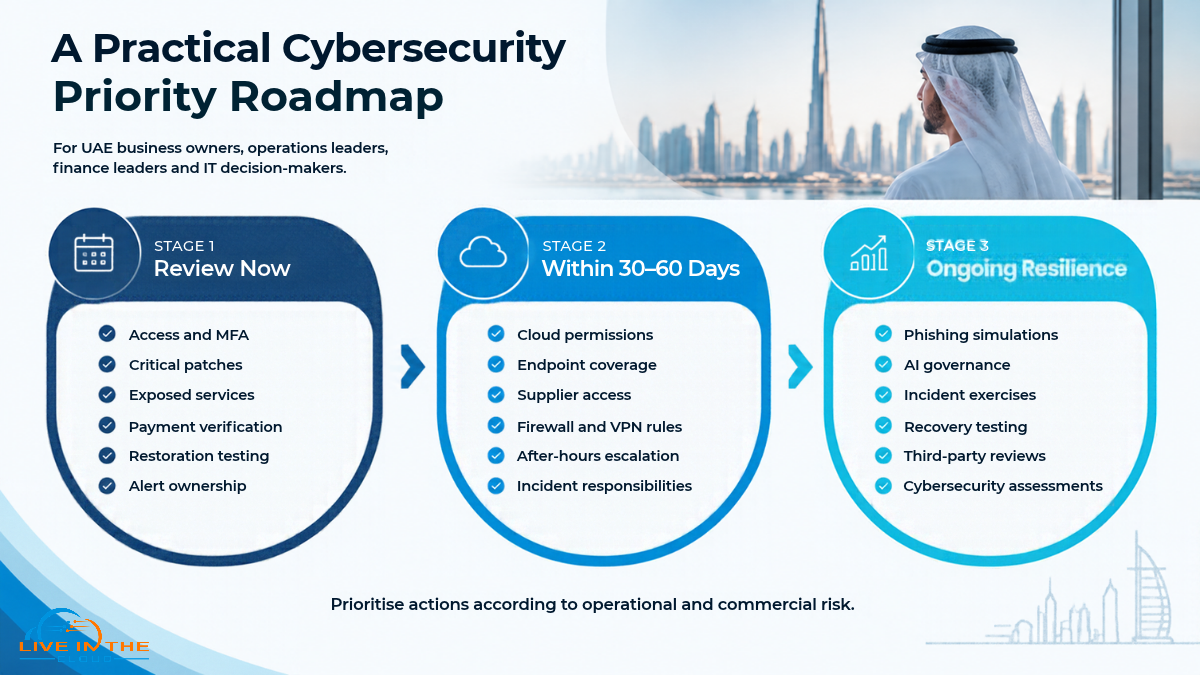
Businesses should begin with actions that reduce immediate operational and financial exposure.
Review immediately
- Remove former-employee and dormant accounts
- Confirm multifactor authentication coverage
- Protect administrative accounts
- Review internet-facing systems and remote services
- Apply urgent patches to high-risk systems
- Confirm payment-verification procedures
- Test whether critical data can be restored
- Identify who receives and investigates security alerts
Review within 30 to 60 days
- Review contractor and supplier access
- Check Microsoft 365 and cloud permissions
- Identify publicly shared files and links
- Confirm endpoint-protection coverage
- Review firewall, VPN and remote-access rules
- Map important third-party applications
- Establish an after-hours escalation process
- Define who can isolate a compromised account or device
Build into ongoing governance
- Run realistic phishing and fraud exercises
- Review employee use of AI tools
- Test the incident-response process
- Review third-party access regularly
- Conduct restoration exercises
- Maintain an inventory of devices and applications
- Reassess important vulnerabilities
- Review cybersecurity readiness as business priorities change
How Live in the Cloud ME helps businesses prioritise cybersecurity risk
Live in the Cloud ME is a Dubai-based, consulting-led Managed Service Provider and Value-Added Reseller supporting businesses across the UAE and GCC.
LITC’s approach begins with the organisation rather than a predetermined product:
- Understand the organisation, its priorities and critical operations
- Review the current technology and security environment
- Assess identities, email, devices, networks, cloud platforms, data and third-party access
- Review monitoring, incident responsibilities, backups and recovery
- Identify security gaps, uncontrolled exposure and unclear ownership
- Prioritise improvements according to operational and commercial impact
- Recommend suitable people, processes, controls, technologies and services
- Support implementation and ongoing management where required
This connected approach to cybersecurity for UAE businesses helps decision-makers understand where the organisation is exposed before committing to individual technologies or disconnected improvements.
Conclusion
The cybersecurity threats UAE businesses face in 2026 are increasingly connected. A compromised identity may expose cloud data. A vulnerable remote-access service may contribute to ransomware disruption. An AI-generated message may exploit a weak finance procedure rather than a technical flaw.
Businesses do not need to address every possible risk at once. They need a reliable view of their most important systems, accounts, data and dependencies, followed by a practical sequence of improvements.
The goal is not to create more security activity. It is to protect the organisation’s ability to operate, serve customers, meet its responsibilities and recover when something goes wrong.
Request a Cybersecurity Assessment
A cybersecurity assessment can help your business understand its current security position, identify priority gaps and define practical next steps based on operational and commercial risk.
Frequently Asked Questions (FAQ)
What are the main cybersecurity threats facing UAE businesses in 2026?
The main threats include phishing, business email compromise, ransomware, identity and account attacks, cloud misconfiguration, vulnerable systems and poorly controlled third-party access. AI is also making fraudulent messages and impersonation attempts more convincing. Businesses should prioritise risks that could affect critical operations, payments, sensitive data and recovery.
How is AI changing cybersecurity risks for businesses?
AI can help attackers produce convincing emails, documents, voice messages and impersonation attempts more quickly. It also creates internal risks when employees enter company information into unapproved AI services. Businesses need clear AI-use policies, approved alternatives, controlled access and verification procedures for sensitive financial or information requests.
Why are identity and email attacks a growing concern?
Business activity increasingly depends on cloud accounts rather than access from one office network. A compromised email or administrator account may provide access to files, applications, payment conversations and company data. Multifactor authentication, least-privilege access, mailbox monitoring and regular account reviews help reduce this exposure.
How can a UAE business assess its cybersecurity readiness?
A cybersecurity readiness assessment should review identities, email, devices, cloud platforms, networks, third parties, vulnerabilities, alert monitoring, backups and incident responsibilities. The findings should connect each gap to its potential business impact and provide a prioritised improvement plan rather than only a technical list of issues.
References and further reading
Official UAE sources
- Emirates News Agency and UAE Cyber Security Council, UAE Cyber Security Council, CPX launch UAE Cyber Factory, 12 May 2026.
View the original announcement - Emirates News Agency and UAE Cyber Security Council, UAE Cyber Security Council, Nozomi Networks forge alliance to advance national cyber capabilities and national resilience, 5 May 2026.
View the original announcemen - UAE Cyber Security Council, national cybersecurity programmes, guidance and awareness resources.
Visit the UAE Cyber Security Council - Telecommunications and Digital Government Regulatory Authority, digital-security guidance and public awareness resources.
Visit TDRA
Official vendor research and resources
- Microsoft Security, security intelligence, identity research and Microsoft Digital Defense Reports.
https://www.microsoft.com/en-us/security/security-insider/intelligence-reports - FortiGuard Labs, ransomware, malware, vulnerability and threat-landscape research.
https://www.fortinet.com/fortiguard/labs - Cisco Talos, threat intelligence, vulnerability research and incident analysis.
Explore Cisco Talos Intelligence - Sophos, ransomware findings, threat research and incident-response analysis.
https://www.sophos.com/en-us/content - Cloudflare, DDoS trends and internet threat research.
https://www.cloudflare.com/threat-research/