
Zero Trust Security in the UAE: Reducing Risk in a Hybrid World
In today's interconnected UAE economy, the traditional idea of a secure corporate network, a digital fortress with a strong perimeter, is no longer effective. With the rise of hybrid work, cloud-based applications, and complex supply chains, your critical data and systems are accessed by employees, partners, and customers from anywhere, at any time. This new reality demands a modern approach to security.
This is where a Zero Trust security model becomes essential. It’s not a single product, but a strategic framework for risk management and business resilience. It operates on a simple but powerful principle: never trust, always verify. This guide explains how UAE businesses can adopt a Zero Trust approach to protect their assets, ensure regulatory compliance, and enable secure growth in a cloud-first world.
Table of Contents
Beyond the Perimeter: Why Zero Trust is a Business Necessity for UAE Enterprises
For decades, cybersecurity was built around the "castle-and-moat" concept. You built a strong wall (a firewall) around your office network to keep attackers out. But what happens when your most valuable assets, your data and applications, and your employees are no longer inside the castle? The perimeter dissolves, and the old model breaks down.
Zero Trust is a security philosophy designed for this modern reality. Instead of assuming everything inside the network is safe, it assumes that threats could be anywhere, both inside and outside the traditional network. It demands that every user, device, and application must prove it is trustworthy before being granted access to resources.
- Verify Explicitly: Always authenticate and authorise based on all available data points, including user identity, location, device health, and the application being accessed.
- Use Least Privilege Access: Give users only the access they need to do their jobs, for the shortest time necessary. This minimises the potential damage if an account is compromised.
- Assume Breach: Operate as if an attacker is already inside your network. This mindset forces you to build strong internal controls, like segmenting your network and encrypting all traffic, to prevent attackers from moving freely and accessing sensitive data.
The 2026 Threat Landscape in the UAE
The nature of cyber threats in the UAE is evolving rapidly. Attackers are no longer just targeting networks; they are targeting people. With the growth of digital government services and interconnected business ecosystems, a single compromised user account can have far-reaching consequences. For businesses in sectors like professional services, hospitality, and real estate, protecting client data and maintaining operational continuity is paramount.
Attackers are increasingly using AI to create highly convincing phishing emails and sophisticated identity theft schemes. The "Assume Breach" mindset is therefore a strategic necessity; it shifts your focus from solely trying to prevent breaches to ensuring your business can withstand and quickly recover from an attack, limiting its impact.
Regulatory Drivers: NESA and the UAE Cybersecurity Council
Adopting a Zero Trust framework is not just a good security practice; it's also a critical step towards meeting the UAE's evolving regulatory standards. The UAE National Cybersecurity Strategy and frameworks from the National Electronic Security Authority (NESA) emphasise the need for proactive, resilient security controls.
Zero Trust directly supports these goals. By enforcing strict identity verification and least privilege access, you create a detailed audit trail for every access request. This provides the visibility and control needed to demonstrate compliance and assure stakeholders, investors, and customers that you are effectively managing cyber risk and protecting sensitive information.
How Zero Trust Works: The Core Components
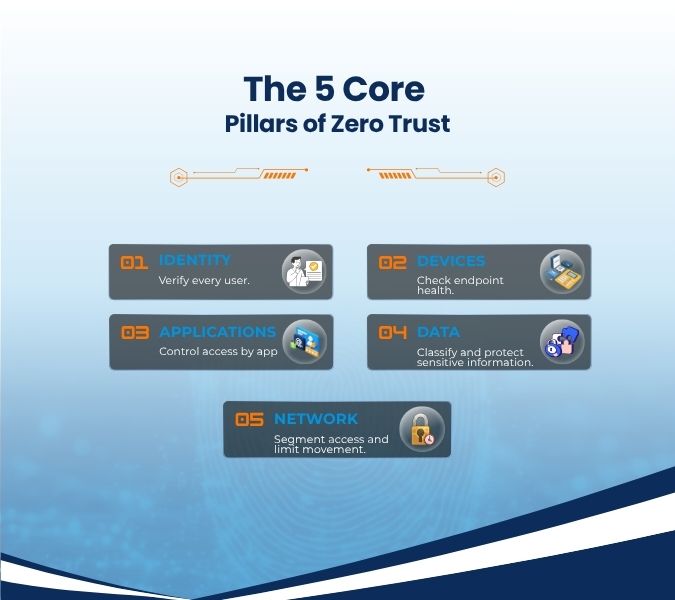
A successful Zero Trust strategy is built on several interconnected pillars that work together to continuously verify every access request. Instead of a single checkpoint at the network edge, it creates multiple checkpoints across your entire IT environment, from the user to the data itself.
- Identity: This is the foundation of Zero Trust. It involves verifying the identity of every user and device, ensuring they are who they say they are before granting access.
- Devices (Endpoints): It's not enough to know who the user is; you also need to know if the device they are using (a laptop, phone, or tablet) is secure, up-to-date, and free from malware.
- Applications: Access policies are applied to each application, ensuring that users can only access the specific apps they are authorised to use.
- Data: By classifying and labelling your data, you can apply specific security policies to protect your most sensitive information, no matter where it is stored or who is accessing it.
- Network: Instead of a single, open internal network, Zero Trust uses techniques like micro-segmentation to create small, isolated zones. This is like having secure doors between departments in an office; if one area is compromised, the breach is contained and cannot spread.
Identity as the New Security Foundation
In a world without a network perimeter, identity is the primary control plane. A robust identity strategy is the starting point for any Zero Trust journey. This involves implementing Multi-Factor Authentication (MFA), a simple but highly effective control that requires users to provide two or more verification factors to gain access. This prevents unauthorised access even if a user's password is stolen.
Furthermore, the principle of "Least Privilege Access" is crucial. For a hospitality group, this might mean a front-desk employee can access the booking system, but not the financial records. For a professional services firm, a contractor might be given temporary access to a specific project folder, but nothing else. This approach dramatically reduces the potential blast radius of a compromised account.
Workload and Data Security in a Hybrid Environment
Whether your business-critical applications run in a public cloud, a private data centre, or as a SaaS subscription, Zero Trust principles can be applied to secure them. The goal is to protect the application and its data regardless of where it is hosted.
A vital first step is data classification, understanding what your most critical data is, where it resides, and who should have access to it. Once you know what you need to protect, you can enforce security policies like encryption for data both at rest (in storage) and in transit (as it moves across the network). This ensures that even if data is intercepted, it remains unreadable and secure.
A Modern Alternative to VPNs: Understanding ZTNA
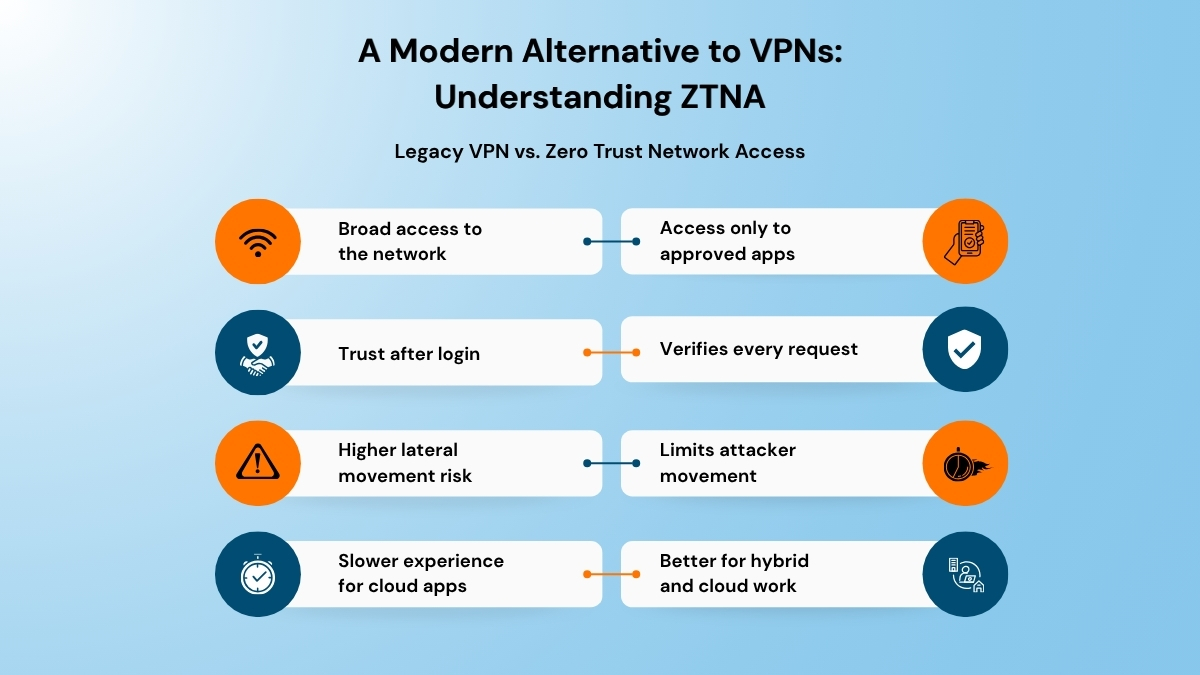
For years, Virtual Private Networks (VPNs) were the standard for providing remote access to corporate networks. However, they were designed for a different era and present significant challenges for the modern, hybrid workforce in the UAE.
Zero Trust Network Access (ZTNA) is a modern approach that replaces traditional VPNs. Instead of granting a user full access to the entire network, ZTNA provides secure, direct access only to the specific applications they need. This fundamentally reduces the organisation's attack surface, as applications are hidden from the public internet and can only be accessed by verified and authorised users.
Why Traditional VPNs Fall Short for the Modern UAE Workforce
Many multi-site organisations and businesses with remote employees find that legacy VPNs create more problems than they solve. They often introduce latency and performance issues, especially when employees are trying to access cloud-based applications, as traffic has to be routed back through a central data centre.
More importantly, VPNs pose a major security risk. Once an attacker compromises a user's VPN credentials, they are effectively "on the network" and can often move laterally to discover and access other sensitive systems. The administrative burden of managing and scaling legacy VPN hardware across multiple locations also adds significant cost and complexity for IT teams.
The Business Case for Moving to ZTNA
Migrating from VPN to ZTNA offers clear business benefits that go beyond security. It improves the user experience for employees, partners, and contractors by providing faster, more reliable, and seamless access to the applications they need to be productive.
From an operational perspective, cloud-native ZTNA solutions reduce management complexity and shift costs from capital-intensive hardware (CapEx) to a more predictable subscription model (OpEx). For UAE businesses undergoing cloud migration, ZTNA acts as a key enabler, providing a secure and consistent way to connect users to applications, regardless of whether they are on-premise or in the cloud.
Implementing Resilience: A Roadmap for UAE Zero Trust Adoption
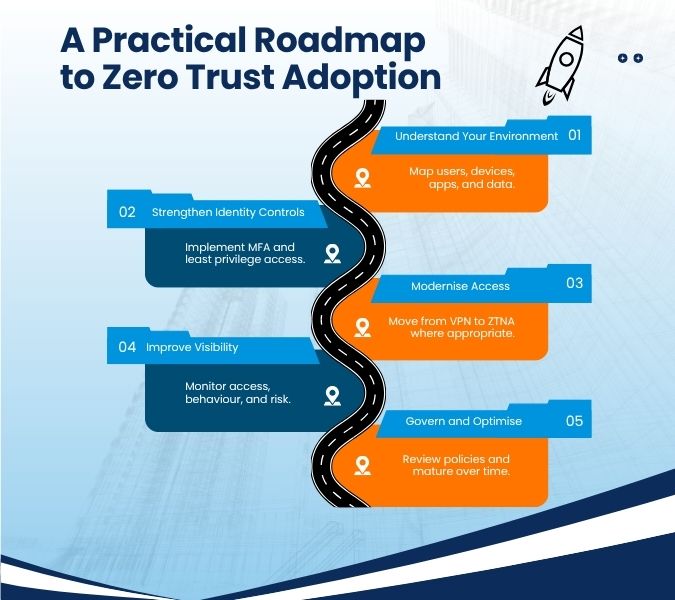
Transitioning to a Zero Trust model is a journey, not a destination. It should be approached as a phased, strategic initiative that delivers incremental value and improvements over time. A practical roadmap helps ensure the transition is smooth and aligns with your business priorities.
- Phase 1: Understand Your Environment. The first step is to gain visibility. This involves identifying your most critical applications and data, mapping how data flows across your organisation, and understanding who needs access to what.
- Phase 2: Strengthen Identity Controls. Consolidate your identity systems and enforce strong authentication everywhere. This typically involves rolling out Multi-Factor Authentication (MFA) to all users as a foundational security control.
- Phase 3: Secure Network Access. Begin implementing ZTNA to replace legacy VPNs for remote users and third-party vendors. At the same time, start introducing network micro-segmentation to limit the potential for lateral movement within your network.
- Phase 4: Improve Visibility and Response. Deploy tools that provide continuous monitoring and analytics across your IT environment. This allows your security team to detect and respond to potential threats in real time.
- Phase 5: Govern and Optimise. Zero Trust is an ongoing process. Regularly review and refine your access policies, audit your security controls, and measure your progress to ensure your security posture continues to mature and adapt to new business needs and threats.
Conducting a Zero Trust Maturity Assessment
Before embarking on this journey, it's critical to understand your starting point. A Zero Trust maturity assessment helps you benchmark your current security capabilities against best practices. This process identifies your biggest risks and most significant gaps, allowing you to create a prioritised, practical plan that focuses on delivering the most impactful improvements first.
Securing executive buy-in is essential for success. Framing the initiative around business risk reduction, operational resilience, and regulatory compliance, rather than just technology, helps align all stakeholders behind a shared vision for a more secure organisation.
Overcoming Common Implementation Hurdles
Every organisation faces unique challenges during a Zero Trust transition. Some may have legacy applications that don't support modern authentication methods. Others may worry about balancing stricter security controls with a seamless and productive user experience for their employees.
The key to overcoming these hurdles is a pragmatic, phased approach. An experienced partner can help you develop strategies for securing legacy systems and design access policies that are both strong and user-friendly. By focusing on gradual implementation and clear communication, you can ensure business continuity and build momentum for the programme.
A Consulting-Led Partner for Your Zero Trust Journey
Implementing a Zero Trust framework is a strategic business initiative that requires more than just new technology. It requires a clear vision, a practical roadmap, and deep expertise in identity, networking, and security. Live in the Cloud ME acts as your consulting-led technology partner, providing the guidance and hands-on support to navigate this transition successfully.
We help you move from a high-level concept to a fully realised security model that protects your business and enables your growth. Our focus is on delivering tangible outcomes: reduced risk, improved compliance, and a more resilient and agile organisation.
A Vendor-Neutral Approach to Cybersecurity
Your business is unique, and your security solutions should be too. Our recommendations are always based on your specific objectives and budget, not on vendor sales targets. We take a vendor-neutral approach, leveraging our expertise across leading technology providers, including Microsoft, Fortinet, Cisco, and others, to design and integrate a unified security framework that is the best fit for your environment.
Our role is to serve as your trusted advisor, helping you cut through the complexity and select the right tools to achieve your security and business goals.
Elevating Your Security with Managed IT Services
A Zero Trust model is not a "set it and forget it" solution. The threat landscape is constantly changing, and your security controls must evolve with it. Our role as your partner doesn't end after implementation. Through our ongoing managed IT services, we provide the continuous monitoring, management, and optimisation needed to ensure your Zero Trust framework remains effective over the long term.
With over 15 years of experience in the technology sector, we have the regional maturity and technical expertise to be your single point of accountability for your entire IT environment, giving you the peace of mind to focus on running your business.
Looking to strengthen security, improve access controls and reduce cyber risk?
Contact LITC for a practical review of your current security posture and recommendations tailored to your organisation.
Frequently Asked Questions (FAQ)
What is Zero Trust and why is it essential for UAE businesses?
How does Zero Trust help with NESA and UAE Cybersecurity Council compliance?
Zero Trust provides the granular visibility and strict access controls required by regulatory frameworks like NESA. By logging every access request and enforcing the principle of least privilege, it helps you demonstrate that sensitive data is being protected and accessed only by authorised users, which is a core component of modern governance and compliance.
Can Zero Trust be implemented without replacing all our existing IT infrastructure?
Yes, absolutely. Zero Trust is a framework and a strategy, not a wholesale replacement of your IT. It can be implemented in phases, integrating with and enhancing your existing infrastructure. A good starting point is often strengthening identity controls with MFA and replacing legacy VPNs with ZTNA, both of which can be done without disrupting core business operations.
Does Zero Trust security negatively impact employee productivity?
When implemented correctly, Zero Trust can actually improve employee productivity. Modern approaches like ZTNA provide faster and more reliable access to applications than traditional VPNs. By moving towards passwordless authentication and single sign-on (SSO), you can reduce friction for users while simultaneously increasing security.
How is the modern ZTNA approach better than our old company VPN?
A traditional VPN grants users broad access to the entire corporate network, which is a major security risk. ZTNA (Zero Trust Network Access) is much more secure because it connects a user directly and only to the specific applications they are authorised to access. This reduces the "attack surface" and prevents an attacker from moving laterally across your network if an account is compromised.
Is Zero Trust only for large corporations, or can SMEs benefit as well?
Zero Trust is a scalable framework that benefits organisations of all sizes. For SMEs, the business risks associated with a data breach or operational disruption can be even more severe. Cloud-based Zero Trust solutions are often more affordable and easier to manage than traditional hardware-based security, making them highly accessible for mid-market and growing businesses in the UAE.
What is the first step my organisation should take toward Zero Trust adoption?
The best first step is to gain a clear understanding of your current security posture. A Zero Trust readiness or maturity assessment will help you identify your critical assets, biggest risks, and most logical starting points. Often, the highest-impact first projects are implementing Multi-Factor Authentication (MFA) across all users and developing a plan to modernise remote access.