
Executing a Seamless Cloud Migration in the UAE: A Strategic 2026 Roadmap
For enterprises in the UAE, the conversation around cloud migration has fundamentally shifted. It is no longer a question of if, but how to execute a move that modernises infrastructure, enhances operational resilience, and aligns with the nation's stringent data sovereignty laws. A successful migration is a complex undertaking that requires a detailed plan, deep technical expertise, and a clear understanding of the regional regulatory landscape.
This guide provides a practical, five-phase framework for IT directors, COOs, and technology leaders. It outlines a structured approach to migrating to the cloud in the UAE, focusing on minimising downtime, ensuring compliance, managing costs, and building a foundation for future innovation.
Table of Contents
The Business Case for Cloud Migration in the UAE
Cloud migration is the process of moving an organisation's digital assets - applications, data, and IT infrastructure - from on-premises servers to a cloud-based environment. Within the context of the UAE's rapidly advancing digital economy, this is more than a simple hardware refresh. It is a foundational move toward a more resilient, scalable, and agile operational model. The primary drivers for this shift are operational resilience, cost optimisation, and improved business agility.
Key Drivers for Modernisation
Organisations across the UAE are adopting cloud infrastructure to move beyond the limitations of legacy systems and capitalise on new opportunities. The core motivations include:
- Modernising Infrastructure: Replacing ageing on-premises hardware with modern, virtualised infrastructure reduces maintenance overhead, improves performance, and eliminates capital expenditure on physical servers.
- Improving Resilience and Business continuity: Cloud platforms offer robust, built-in disaster recovery and backup capabilities, ensuring business operations can continue uninterrupted during hardware failures or other disruptions.
- Enabling Future Innovation: A flexible cloud environment is a prerequisite for adopting advanced technologies. It provides the scalable computing power necessary for data analytics, business intelligence, and, eventually, artificial intelligence (AI) workloads.
Addressing the "Why Now?" Question
Several factors make cloud migration an urgent priority for UAE-based enterprises. The rising cost of maintaining and cooling aging on-premises data centres is a significant financial drain. Simultaneously, cloud-first competitors are leveraging the agility of platforms like AWS and Azure to innovate faster and scale more efficiently. Furthermore, as hybrid and remote work models become standard, a centralised, secure, and accessible cloud infrastructure is essential for supporting a distributed workforce and ensuring seamless collaboration across the nation.
A 5-Phase Framework for Executing a Seamless Migration
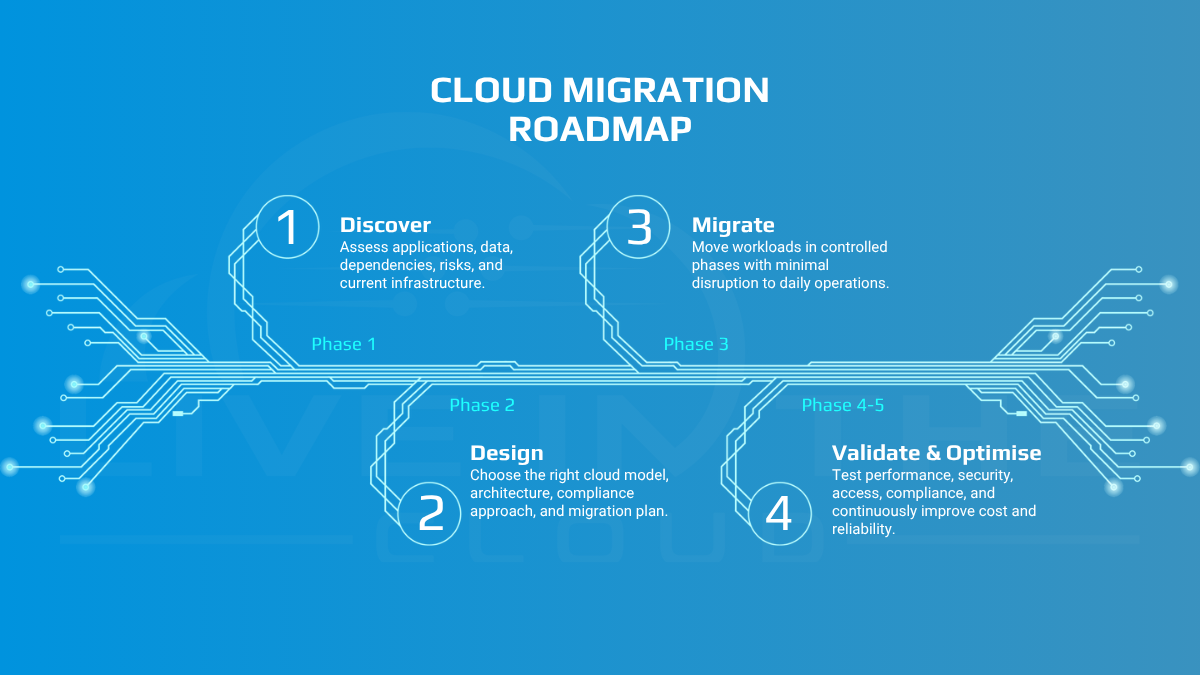
A successful cloud migration in the UAE is not a single event but a meticulously planned process. This five-phase framework breaks down the journey into manageable stages, ensuring that every technical, commercial, and compliance requirement is addressed methodically to minimise risk and maximise return on investment.
- Phase 1: Comprehensive Discovery and Workload Assessment. The critical first step is to gain a complete understanding of your current IT environment.
- Phase 2: Architecture Design and Vendor Selection. With a clear inventory, you can design the target cloud architecture that aligns with your business objectives.
- Phase 3: Execution and Data Transfer. This is the technical implementation phase, where workloads are moved to the cloud using proven, zero-downtime protocols.
- Phase 4: Rigorous Validation and Compliance Auditing. After the migration, every application and system is tested to confirm it functions correctly and meets all performance and security benchmarks.
- Phase 5: Continuous Optimisation and Managed Support. The cloud journey doesn't end at cutover. This final phase involves ongoing management to control costs, optimise performance, and ensure the environment remains secure.
Discovery and Assessment: The Foundation
Before any migration begins, a thorough audit of your existing IT assets is essential. This process involves identifying all applications and categorising them as "cloud-ready" or "legacy-heavy," with the latter often requiring a more complex modernisation strategy. A key output of this phase is a detailed analysis of the total cost of ownership (TCO) for various cloud models, comparing your current on-premises spend with projected operational costs in the cloud. This stage must also map all application dependencies to prevent unexpected disruptions during the migration.
Execution and Validation
To minimise the impact on business operations, a phased migration approach is typically recommended. This involves moving non-critical workloads first, followed by more complex, business-critical applications. Throughout this process, ensuring data integrity is paramount, especially during large-scale transfers across national networks. Once the migration is complete, post-migration audits are performed to verify that all security controls are in place, performance meets or exceeds pre-migration levels, and the new environment is fully compliant with UAE regulations.
Navigating UAE Data Sovereignty and Compliance
For any organisation operating in the UAE, compliance with data sovereignty and residency laws is non-negotiable. The regulatory landscape, shaped by authorities like the Telecommunications and Digital Government Regulatory Authority (TDRA) and the National Electronic Security Authority (NESA), dictates how and where certain types of data can be stored and processed. Understanding these rules is fundamental to a successful cloud migration strategy.
The Legal Landscape of UAE Cloud Storage
The UAE Data Protection Law and other sector-specific regulations impose strict requirements on handling sensitive information. For critical sectors such as finance, healthcare, and government, regulations often mandate that personally identifiable information (PII) and other sensitive data must be hosted within data centres located physically inside the UAE. This has led all major cloud providers, including AWS, Microsoft Azure, and Google Cloud, to establish in-country cloud regions to meet these data residency requirements. Failure to comply can result in significant financial penalties and reputational damage.
Choosing the Right Cloud Model for Compliance
Selecting the appropriate cloud model is a critical decision that directly impacts your compliance posture, security, and scalability. Each model offers distinct advantages:
- Public Cloud (AWS, Azure, Google Cloud): Ideal for workloads that require global scalability and do not handle highly sensitive, regulated data. These platforms offer a vast array of services and a pay-as-you-go model, making them cost-effective for a wide range of applications.
- Private Cloud: A dedicated environment for a single organisation, offering the highest level of control and security. This model is often chosen by government entities or financial institutions that need to meet strict data sovereignty requirements and maintain complete authority over their infrastructure.
- Hybrid Cloud: A balanced approach that combines public and private clouds, allowing organisations to keep sensitive data on a private, compliant server while leveraging the public cloud for less sensitive applications, development, and disaster recovery. This is the most common model for complex enterprises in the UAE.
Mitigating Risks: Security, Downtime, and Cost Overruns
While the benefits of cloud migration are clear, the process is not without risk. A proactive strategy for managing security, preventing downtime, and controlling costs is essential for a successful transition. Addressing these challenges head-on will ensure the project stays on track and delivers the expected business value.
Securing the Migration Pipeline
Security must be integrated into every phase of the migration. This starts with implementing a Zero Trust architecture, which operates on the principle of "never trust, always verify" and treats every access request as a potential threat. Data must be encrypted both in transit as it moves to the cloud and at rest once it resides in the new environment. A robust Identity and Access Management (IAM) policy becomes the new security perimeter, ensuring that only authorised users can access specific resources. Leading security technologies from partners like Fortinet and Sophos can be deployed to secure cloud-native workloads against sophisticated threats.
Cost Management and Optimisation
Without careful management, cloud costs can quickly spiral out of control. A common issue is "cloud sprawl," where unused or oversized resources accumulate, leading to wasted expenditure. To prevent this, it is crucial to implement cost management best practices from day one. This includes "rightsizing" virtual machine instances to match workload demands, leveraging reserved instances for predictable workloads to secure discounts, and using automated tools to track and optimise cloud spend. Strategic procurement and licensing management are also key to controlling recurring costs.
Choosing the Right Partner for Your UAE Cloud Migration
Executing a complex cloud migration requires more than just technical skill; it demands deep regional expertise, a proven methodology, and a vendor-neutral perspective. The right partner acts as an extension of your IT team, providing guidance and a single point of accountability from initial assessment through to ongoing management.
A Consulting-Led, Vendor-Neutral Approach
A vendor-neutral approach is essential for designing a cloud solution that truly serves your business objectives, not a specific technology vendor's sales targets. An effective partner begins with a consulting-led process to understand your budget, compliance needs, and long-term goals. With expertise across major platforms like AWS, Azure, and Google Cloud, they can architect a hybrid or multi-cloud solution that offers the best combination of performance, cost, and compliance for your unique requirements. This combination of deep regional knowledge and multi-platform expertise ensures your technology choices are sound, sustainable, and aligned with your business.
Next Steps for Your Cloud Journey
A successful cloud migration modernises your infrastructure and positions your organisation for sustained growth. The process begins with a professional workload assessment to create a clear, data-driven plan. By aligning technology investments with your business goals, you can build a secure, resilient, and efficient cloud environment ready to support your operations today and enable innovation tomorrow. After the migration is complete, ongoing support from a provider of managed IT services can help you optimise costs and ensure your environment remains secure and high-performing.
Schedule a strategic cloud migration consultation with our experts to begin building your roadmap.
Planning a cloud migration or reviewing your current infrastructure?
Live in the Cloud ME can help you assess your environment, identify cloud-ready workloads, review data residency requirements, and build a practical migration roadmap aligned to your business goals.