
Automation and Optimisation: The Real Competitive Edge for Modern Businesses
The Problem Isn't Your Technology
Most organisations don’t start with broken systems. They start with solid tools. A CRM for sales. Accounting software for finance. Project trackers for delivery. Support platforms for customers. Each solves a specific problem. But as teams grow and processes evolve, those systems drift apart.
- Data gets trapped.
- Work gets duplicated.
- Teams lose visibility.
- Decisions slow down.
At Live in the Cloud ME, we see this across every industry. Companies collect more data, adopt more apps, and shift deeper into the cloud. But without connected operations and workflow optimisation, teams spend more time managing technology than using it to drive outcomes.
We look at automation and optimisation with no platform bias, no product push. Just practical guidance on building a scalable, resilient digital ecosystem that supports your business rather than holding it back.
What You Gain When Systems Work Together
Picture the simplest workflow in any organisation:
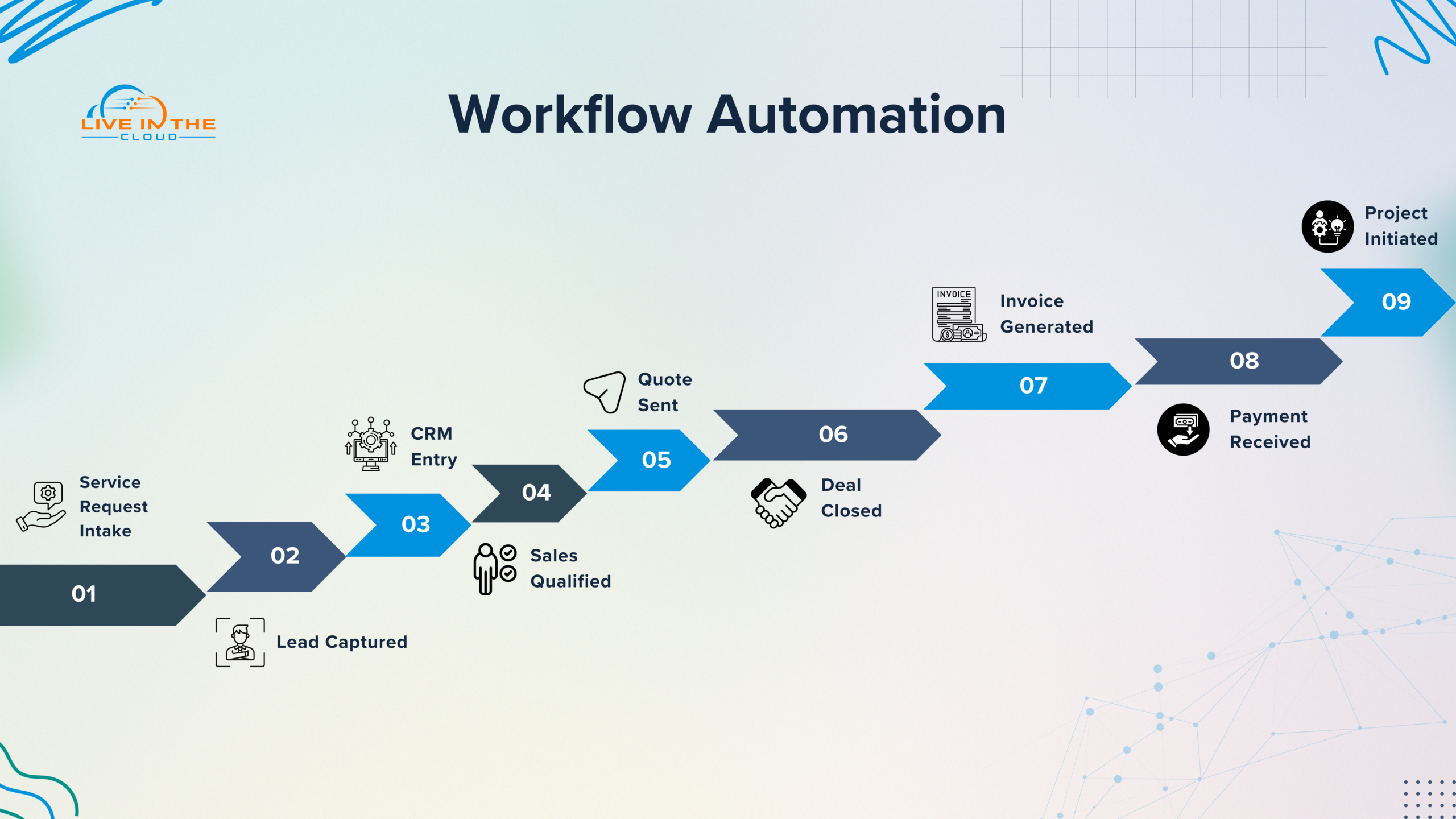
BD generates lead → Sales closes the deal → Finance invoices → Logistics delivery.
If these steps live in fragmented systems, you get inconsistent data, manual handoffs, and operational drag.
Connected operations remove that friction entirely.
Here’s what that looks like:
- Data visibility moves automatically between departments
- Manual entry points disappear
- Workflows trigger at the right time
- Teams share one accurate version of information
This is where real optimisation begins, not by adding more tools, but by making the ones you already use work together.
Processes will shift and there is a learning curve, but the gains in accuracy, speed, and clarity consistently outweigh the effort.
What You Gain When Systems Work Together
Picture the simplest workflow in any organisation:
BD generates lead → Sales closes the deal → Finance invoices → Logistics delivery.
If these steps live in fragmented systems, you get inconsistent data, manual handoffs, and operational drag.
Connected operations remove that friction entirely.
Here’s what that looks like:
- Data visibility moves automatically between departments
- Manual entry points disappear
- Workflows trigger at the right time
- Teams share one accurate version of information
This is where real optimisation begins, not by adding more tools, but by making the ones you already use work together.
Processes will shift and there is a learning curve, but the gains in accuracy, speed, and clarity consistently outweigh the effort.
Real-World Results from Connected Operations
Platforms evolve and users adapt, but the real breakthroughs happen when systems finally work together.
We’ve seen this repeatedly across Zoho, Salesforce, Microsoft, and custom-built platforms. When organisations align their systems, automate the processes between them, and remove the friction between teams, the results are consistently measurable and transformative. Here are real-world examples that prove it.
Microsoft Power Automate - Turning Manual Workflows into ROI
A global organisation highlighted in a Forrester Total Economic Impact (TEI) study transformed thousands of hours of repetitive work by automating approvals, data entry, notifications, and cross-system updates using Power Automate. What once required long email trails and manual checks became a streamlined workflow that touched CRM, finance, HR, and operations without human intervention. This not only removed administrative burden but also gave leaders real-time visibility and reduced error rates across the business.
The result was a documented 199 percent ROI, more than 26,000 hours saved annually, and a 50 percent reduction in development effort. It clearly shows that meaningful optimisation comes from connecting systems, not adding more of them.
Source and link: Forrester TEI for Microsoft Power Automate
https://tei.forrester.com/go/microsoft/powerautomatetei/docs/TEI_of_Microsoft_Power_Automate_PDF.pdf
Zoho One - When Departments Finally Work Together
A Zoho One case study highlights how a mid-sized company unified CRM, finance, HR, operations, and support into a single, connected suite. Before consolidation, every department worked on different tools, causing duplicated work, inconsistent reporting, and weeks-long delays in decision-making. Once migrated to Zoho One, they automated cross-department flows, connected sales to billing, introduced shared dashboards, and removed multiple legacy systems.
The impact was immediate: 40 percent faster sales cycles, a 30 percent drop in operational inefficiencies, and significantly improved reporting accuracy because data finally flowed in one direction. This demonstrates how integration simplifies complexity better than any single standalone system can.
Source and link: Zoho One Customer Stories
https://www.zoho.com/one/customers.html
Salesforce + ERP Integration – Eliminating Data Silos
According to Nucleus Research, organisations that integrated Salesforce with ERP systems (SAP, Oracle, Dynamics, Zoho, etc.) reported major improvements in revenue operations. Sales teams finally had real-time visibility into inventory, pricing, finance, and fulfilment data that previously sat in siloed systems. This alignment eliminated double-entry, reduced quote-to-cash friction, and gave leadership a real-time view of forecasts, orders, and delivery timelines.
The integrated organisations recorded a 20 to 30 percent improvement in sales productivity and far more accurate forecasting, enabling faster decisions and fewer delays across the customer lifecycle.
Source and link: Nucleus Research - CRM and ERP Integration Insights
https://nucleusresearch.com/research/single/crm-technology-value-matrix-2023/
Unified Communications - When Voice, Video, and Data Work as One
Cisco’s business value research shows how organisations connecting messaging, calling, and collaboration tools into a unified communications setup significantly improve internal and external responsiveness. One enterprise example showed decision-makers cutting project delays by reducing communication gaps between teams and departments. Another case highlighted customer service teams resolving issues faster because information flowed freely across chat, call logs, CRM data, and ticketing platforms.
The results included 33 percent faster decision-making, up to 42 percent better response times, and a much more secure communication environment that reduced shadow IT.
Source and link: Federal New Network - Cisco Unified Communications
Microsoft Teams + Phone System - Streamlined Collaboration
Frost & Sullivan’s research demonstrates how organisations fully adopting Microsoft Teams with integrated calling and device management saw a dramatic reduction in operational friction. With meetings, calls, documents, and workflows happening in one unified environment, cross-functional teams removed constant switching between apps and reduced delays caused by disconnected communication systems.
Companies reported a 19 percent drop in project delays, 17 percent faster incident resolution, and better alignment between departments because everything happened within the same ecosystem.
Source and link: Frost & Sullivan Modern Workplace Study
AI + Business Applications - Automating High-Value Work
McKinsey’s global AI research shows that companies connecting AI to CRM, finance, HR, operations, and support systems outperform those using AI in isolation. When AI is embedded directly into workflows to summarise data, generate insights, automate decisions, or eliminate manual steps, organisations experience a measurable jump in productivity and accuracy.
The research shows 20 to 40 percent productivity gains, particularly in decision-heavy roles like sales, service, finance and operations. This reinforces that AI delivers maximum value when paired with well-integrated systems and clean data flows.
Source and link: McKinsey - Superagency in the workplace: Empowering people to unlock AI’s full potential
Multi-System Orchestration - The Biggest Gains Come from Integration
A Gartner insight reveals that organisations connecting at least three core systems (CRM, ERP, Support, UC, AI, etc.) experience a 50 percent reduction in operational drag. By orchestrating workflows between tools, they removed manual re-entry, improved visibility between teams, and enabled smoother approvals across departments.
This finding supports the core theme of your article: real optimisation doesn’t come from adding tools, it comes from making them work together.
Source and link: Gartner Workflow Integration & Productivity Insights
What Optimisation Really Means
Optimisation isn’t about adding more software. It’s about intentionally designing how information and work move across your organisation.
That looks like:
- Clean data flow between teams
- Eliminated duplication
- Automated routine tasks
- Clear, measurable processes
- Reduced operational friction
Once these fundamentals are in place, performance improves across sales cycles, delivery efficiency, service quality, reporting, and compliance.
Where Automation Delivers Immediate Impact
Most organisations already own powerful tools. What they lack is the orchestration that turns those tools into a unified, intelligent workflow.
Sales and Customer Operations
- Intelligent lead routing based on priority, territory, or behaviour
- CRM connected to finance, inventory, and fulfilment
- Automatic activation of delivery, onboarding, or provisioning workflows
Finance and Approvals
- Faster, structured approval paths with full audit history
- Instant generation of invoices, POs, and payment requests
- Dramatically fewer reconciliation errors and manual touchpoints
Service and Support
- A unified customer view across tickets, communication, and account data
- Automated SLAs, escalations, and follow-ups that ensure consistency
- Seamless service experiences across chat, email, phone, and self-service
Business Intelligence and Reporting
- Consolidated data from disconnected systems and teams
- Real-time dashboards that replace static reporting cycles
- Reduced spreadsheet dependency and higher data accuracy
Whether your ecosystem includes CRM and ERP, communication and UC platforms, productivity tools, AI assistants, or custom applications, the biggest gains come from connecting the technology you already have.
Choosing the Right Technology Path
The real question isn’t “Which CRM should you buy?” It’s “What do you need your systems to do together?”
Technology decisions should start with outcomes, not brand names. Different goals require different strengths:
- End-to-end operational visibility: Platforms such as Zoho and Microsoft Dynamics offer broad native connectivity across departments, making them ideal for organisations looking for unified workflows.
- Highly customised, enterprise-scale processes: Some organisations choose platforms known for deep flexibility and modular extensibility, though these typically come with higher complexity and long-term ownership considerations.
- Lightweight workflows built around speed and productivity: Cloud-first productivity tools, collaboration suites, and AI assistants can accelerate adoption and streamline simple processes without heavy system overhead.
Here’s the key: No single platform wins every scenario. The right choice depends on your process design - not software popularity.
The Goal: Business Agility
Agility isn’t a buzzword - it’s a measurable business advantage. When systems connect and processes flow without friction, organisations reduce decision latency, remove operational drag, and strengthen governance. McKinsey research shows that companies with high process connectivity consistently outperform peers on speed, efficiency, and adaptability.
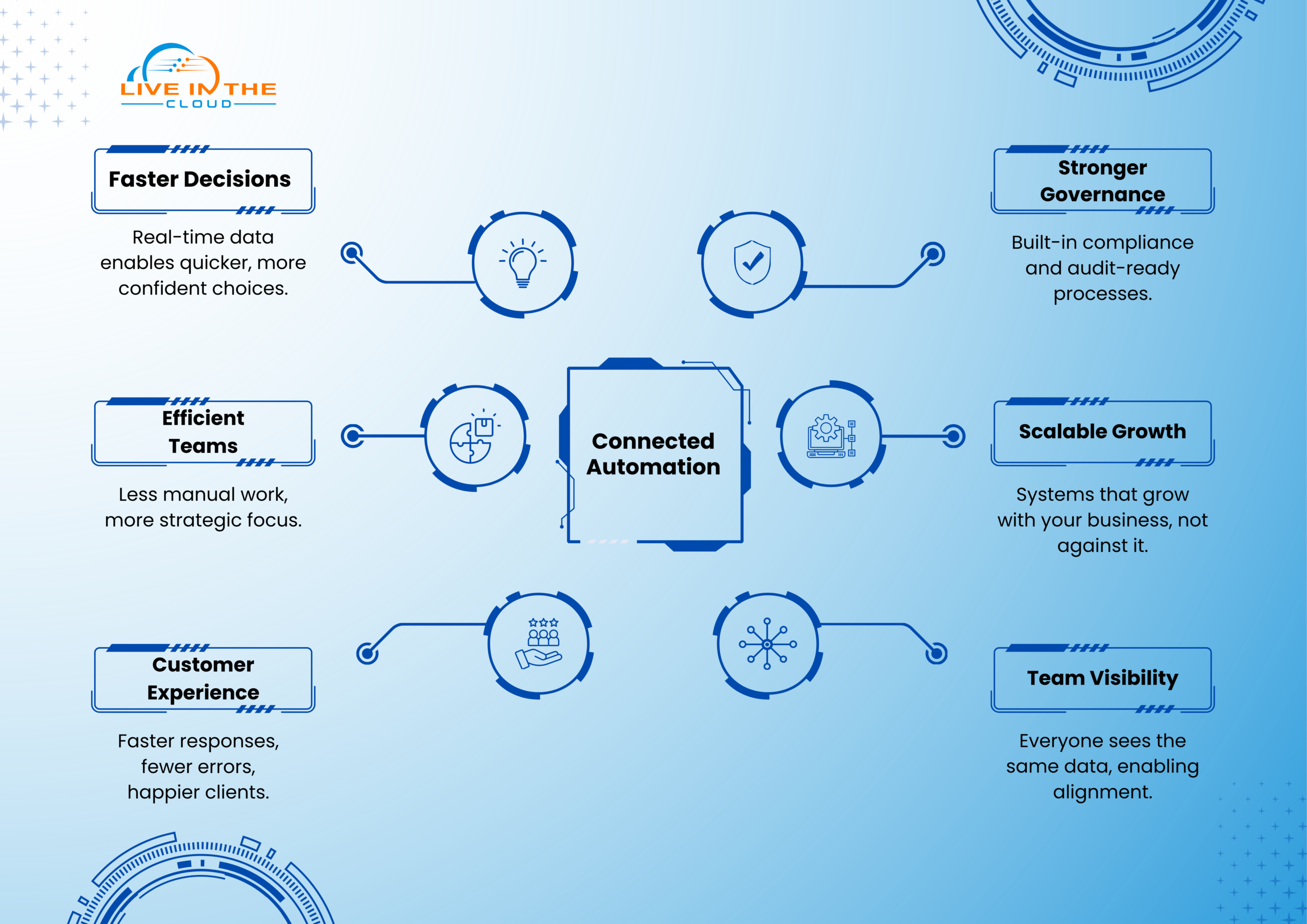
When your tools and data move together, the entire organisation becomes lighter, faster, and more responsive:
- Faster decisions because leaders see the full picture in real time
- More efficient teams because repetitive tasks disappear
- Better customer experiences because service teams have complete context
- Stronger governance because compliance is embedded into workflows
- Scalable growth because technology supports expansion instead of slowing it down
This kind of agility - not the choice of tool - is the real competitive edge.
Want to See What Automation Could Look Like for You?
Most organisations already own great tools - CRM systems, finance platforms, collaboration suites. The real problem isn’t the technology. It’s the gaps between them.
Those gaps create:
- Duplicate data entry
- Delayed handoffs
- Missed follow-ups
- Reporting blind spots
- Decisions made with partial information
Automation closes those gaps. It transforms fragmented processes into connected workflows that run reliably without constant human intervention. Imagine:
- A lead captured in your CRM instantly triggering invoicing, onboarding, or project setup
- Finance approvals moving end-to-end without email chains or bottlenecks
- Inventory, orders, or service updates syncing in real time across systems
- Industry benchmarks consistently show:
- Organisations that integrate key systems see up to 70 percent fewer financial errors
- Unified workflows cut operational costs by 20–30 percent and accelerate delivery timelines by 40 percent
- ROI on automation initiatives often exceeds 300 percent within three years
If you’re exploring how to streamline operations or unify your systems, begin with clarity, not tools. Map your workflows. Identify bottlenecks. Understand where automation can deliver the highest impact.
That’s how you build a technology ecosystem that works for you - not the other way around.
Ready to connect your systems and cut the manual work?
Live in the Cloud ME helps businesses automate workflows, integrate platforms, and improve visibility across teams.