
UAE E-Invoicing Readiness: How Businesses Can Prepare Their Finance Systems
E-invoicing readiness is not simply about changing the format of an invoice. For many UAE businesses, it may affect the accounting platforms, customer records, approval processes and system integrations behind every financial transaction.
If sales, operations, procurement and finance use disconnected applications, invoice information may be copied between systems or corrected manually. These workarounds can make a future e-invoicing implementation more difficult to control.
Preparing early gives businesses an opportunity to identify these gaps before selecting software. It also creates a stronger foundation for finance automation, reporting and operational visibility.
This guide explains the principal areas organisations should assess when preparing their finance systems for UAE e-invoicing.
Key Takeaways
- Review the complete invoice process before selecting technology.
- Check whether existing accounting and ERP systems can be configured or integrated.
- Improve customer and supplier data before automating transactions.
- Include approvals, permissions, reconciliation and exceptions in the design.
- Plan for system administration and support after implementation.
Table of Contents
Why E-Invoicing Readiness Matters
An invoice is the final output of a wider business process. Customer data may originate in a CRM, pricing may come from a sales platform and delivery information may be recorded in an operational system.
Finance depends on this information being accurate before creating the accounting transaction. When the applications are not connected, employees may use emails, spreadsheets or manual uploads to move information between teams.
These processes can work when experienced employees know how to correct problems. They become harder to manage when transaction data needs to pass through a standardised digital workflow.
The purpose of a readiness assessment is therefore to understand how invoices are created today. It should show where information originates, how it is approved, which systems are involved and how errors are resolved.
More Than a Finance Project
Finance should play a leading role, but readiness can also involve IT, procurement, sales operations and application owners.
Finance defines the accounting outcome and control requirements. IT manages integrations, access, security and application support. Operational teams understand where the original transaction information is created.
Bringing these teams together reduces the risk of designing a solution around only the final accounting step.
The Finance Systems Readiness Framework
Preparing for e-invoicing requires a clear view of the systems, data and controls behind every invoice. The review should extend beyond the accounting platform to include the applications and manual processes used across sales, procurement, operations and finance.
A structured assessment helps the business understand what can be retained, what needs improvement and where configuration, integration or wider modernisation may be required.
|
Readiness area
|
What to review
|
Desired outcome
|
|
Accounting and ERP
|
Review platform support, configuration options, integration capability and software ownership. Include any spreadsheets, custom databases or other tools used during invoicing.
|
A stable, scalable, and cost-effective foundation for your business.A clear decision on whether to retain, configure, upgrade, integrate or replace the existing system.
|
|
Customer and supplier data
|
Check for duplicate records, incomplete information, inconsistent business names and unclear data ownership. Confirm which application holds the authoritative record.
|
Accurate and consistently maintained master data for invoice creation.
|
|
Invoice workflows
|
Map invoice creation, approval, correction, credit-note and payment processes. Include manual entry, spreadsheet-based work and email approvals.
|
A documented and controlled invoice journey with fewer unnecessary manual steps.
|
|
System integration
|
Review how information moves between sales, operations, procurement and finance. Document integration dependencies, monitoring and failure ownership.
|
Fewer manual hand-offs and better visibility across the complete transaction process.
|
|
Permissions and audit trails
|
Confirm who can create records, generate invoices, approve changes, resubmit transactions and change system settings.
|
Appropriate user access and a traceable history of transaction activity.
|
|
Testing and reconciliation
|
Test successful invoices, corrections, credit notes, missing information, interrupted integrations and duplicate attempts.
|
Accurate accounting, reliable reconciliation and controlled exception handling.
|
|
Ongoing support
|
Define responsibility for integration monitoring, user administration, application changes, vendor coordination and incident escalation.
|
A stable and supportable operating model after implementation.
|
The objective is not to automate every existing activity or assume that every business needs to replace its ERP. A supported platform may only require configuration, an upgrade or an integration layer.
The assessment should identify where poor data, disconnected systems, manual hand-offs or unclear ownership could affect invoice processing. These findings can then feed directly into the implementation roadmap.
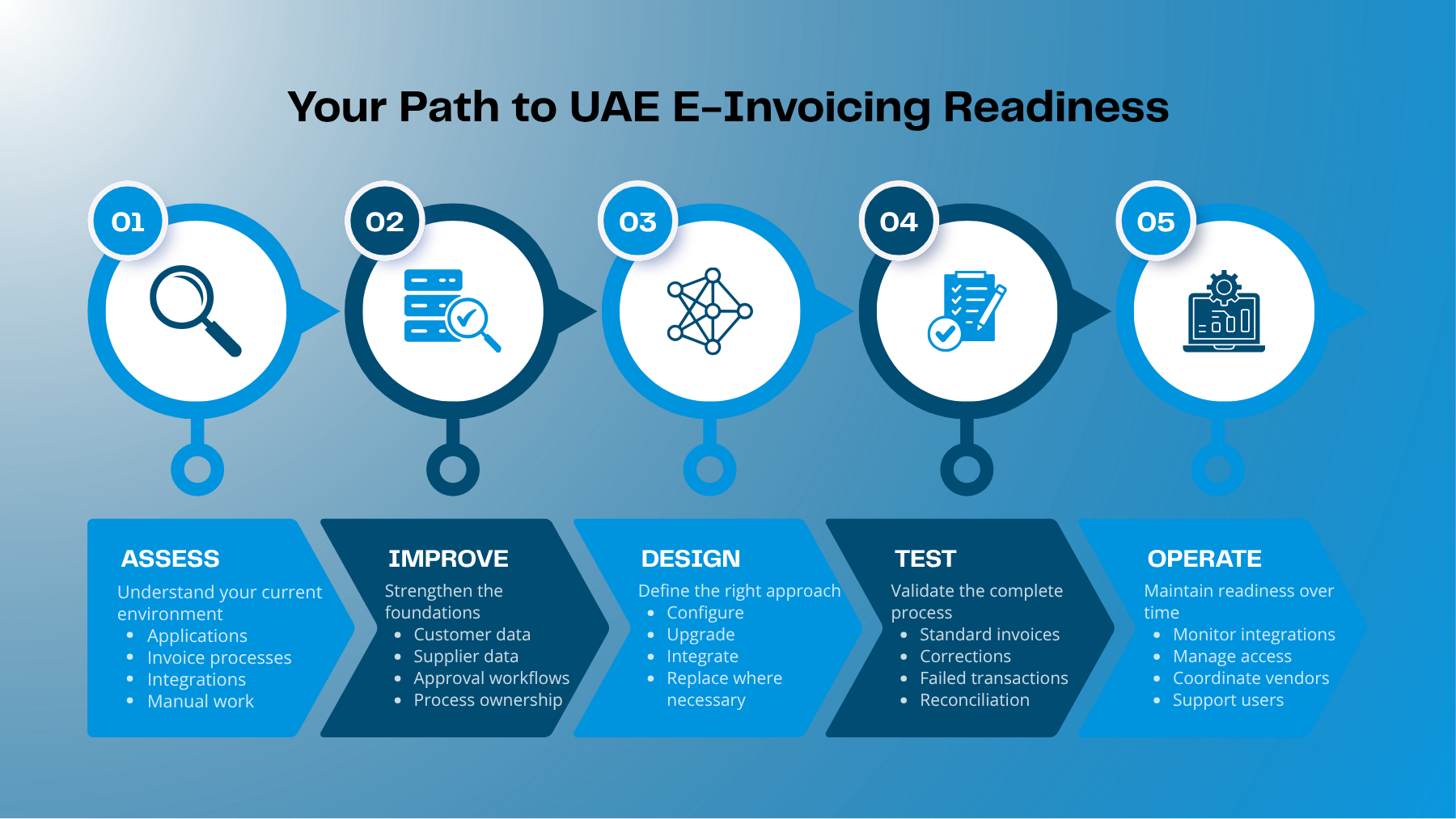
A Practical Implementation Roadmap
Preparing for e-invoicing requires a clear view of the systems, data and controls behind every invoice. The review should extend beyond the accounting platform to include the applications and manual processes used across sales, procurement, operations and finance.
A structured assessment helps the business understand what can be retained, what needs improvement and where configuration, integration or wider modernisation may be required.
- Create an inventory of applications, transaction types, integrations and manual processes. Map where invoice information originates and how it reaches the accounting platform.
- Clean important customer and supplier records. Simplify invoice workflows and introduce clearer ownership for data, approvals and adjustments.
- Compare confirmed requirements with current system capabilities. Evaluate configuration, upgrade, integration and replacement options according to business fit and long-term supportability.
- Test common transactions, adjustments and realistic failure scenarios. Confirm approvals, permissions, accounting outcomes, returned statuses and reconciliation.
- Assign responsibility for integration monitoring, user administration, data quality and vendor coordination. Document support and escalation procedures before the solution becomes part of daily finance operations.
Common Mistakes to Avoid
- Starting with software selection: Understand the finance environment before choosing a product.
- Treating the project as a PDF conversion: Review the structured data and business process behind the invoice.
- Ignoring spreadsheets: Include every tool that influences invoice information.
- Testing only successful transactions: Include corrections, failures and reconciliation.
- Leaving support until the end: Define ownership and administration before implementation.
- Assuming the ERP must be replaced: Assess configuration and integration options first.
The Live in the Cloud ME Approach
Live in the Cloud ME helps businesses select, configure and improve the applications used across finance, sales, operations and internal workflows.
For e-invoicing readiness, LITC can assess the existing application environment, document system dependencies and identify where manual processes or disconnected platforms create risk.
The resulting roadmap can help the organisation decide what to retain, what to integrate and where modernisation may be required. LITC can then support software selection, configuration, integration, testing and continuing application management.
This consulting-led model keeps the technology decision aligned with the organisation’s operating requirements rather than assuming one product is appropriate for every business.
Regulatory and tax interpretations should be validated with qualified advisers. LITC’s role is to translate confirmed requirements into a practical and supportable technology environment.
Preparing Finance Systems for Change
UAE e-invoicing readiness is an opportunity to improve more than invoice processing. It can help businesses strengthen data ownership, reduce manual entry and create better connections between finance and operational systems.
The most effective starting point is a structured assessment. This gives finance and technology leaders a clear view of existing capabilities, important gaps and the most practical route forward.
Before publication or implementation, all effective dates, implementation phases, business scope, technical specifications and provider requirements should be verified against the latest official UAE Ministry of Finance or Federal Tax Authority material.
Planning an E-Invoicing Readiness Assessment?
Live in the Cloud ME can help review your finance applications, data, integrations and workflows before you commit to a technical solution. Talk to LITC about creating a practical UAE e-invoicing readiness roadmap.
Frequently Asked Questions (FAQ)
What is UAE e-invoicing readiness?
It is the ability of a business’s systems, data, workflows and people to support the applicable electronic invoicing requirements reliably.
Will businesses need to replace their ERP?
Not necessarily. Some organisations may be able to configure, upgrade or integrate their existing platform. The decision should follow a systems assessment.
Which systems should be reviewed?
Review accounting, ERP, CRM, procurement, billing and operational applications, together with spreadsheets and custom tools used during invoicing.
What should businesses do first?
Begin by mapping the current invoice process. Identify the applications, data sources, approvals, integrations and manual work involved.
Who should own the readiness programme?
Finance should play a leading role, supported by IT, procurement, operations, tax and relevant application owners.