
SD-WAN Solutions in the UAE: A Strategic Guide for Enterprise Connectivity
Did you know that maintaining legacy MPLS circuits in the UAE can cost your enterprise up to AED 15,000 per site every month, even as performance lags behind your cloud ambitions? For many regional IT leaders, the financial burden of connectivity is rising while the actual agility of the network remains stagnant. Deploying robust SD-WAN solutions UAE enterprises can trust is no longer just a technical upgrade. For many organisations, it has become a practical requirement for supporting cloud services, remote users and multi-site operations to overcome high latency and rigid, expensive contracts. We recognise that your network should support business growth rather than restrict it, not a bottleneck for your digital strategy.
This guide demonstrates how these advanced networking frameworks allow you to modernise, secure, and optimise national infrastructure for the digital era. You'll discover how to transition from legacy hardware to a resilient backbone that offers seamless integration with AWS, Azure, and Google Cloud. We will examine the strategic shift toward software-defined networking that reduces operational complexity, strengthens security at the edge, and provides the scalable foundation your business requires to thrive.
Key Takeaways
- Identify the strategic drivers pushing UAE firms away from rigid MPLS contracts toward agile, software-defined wide area networks.
- Explore how SD-WAN solutions UAE enhance cloud application performance and ensure business continuity by aggregating fibre, LTE, and 5G links.
- Master the technical requirements for aligning your network with NESA standards and critical UAE data residency regulations.
- Evaluate the transition from legacy private circuits to integrated SASE frameworks to accelerate deployment speed and bolster edge security.
- Gain insights into a vendor-neutral advisory approach that simplifies infrastructure management and secures your digital transformation journey.
Table of Contents
The Evolution of Enterprise Networking: Why UAE Firms are Migrating to SD-WAN
The UAE's commercial landscape is undergoing a profound digital shift. As enterprises across the nation embrace cloud-native operations, the limitations of traditional networking have become impossible to ignore. Many UAE firms find themselves anchored by legacy infrastructure that wasn't designed for the demands of a distributed, cloud-centric workforce. For leadership teams, the priority has shifted from merely maintaining connectivity to ensuring that the network serves as a reliable engine for growth, innovation, and resilience.
To understand this shift, we must first answer a fundamental question: What is SD-WAN? At its core, it is a software-defined approach to managing wide area networks. By decoupling the control plane from the physical hardware, it allows businesses to route traffic intelligently across multiple connection types. For organisations seeking high-performance SD-WAN solutions UAE providers offer, this technology represents the essential bridge between technical resilience and business growth. It's about moving away from rigid hardware constraints and toward a model defined by stability, scalability, and strategic alignment.
One of the key drivers behind SD-WAN adoption is the move towards the "Cloud-First" mandate. Legacy backhauling, where cloud traffic is sent to a central data centre before reaching the internet, severely degrades the performance of Microsoft 365, Azure, and Google Cloud. This outdated model creates unnecessary bottlenecks that stifle productivity and frustrate users. By adopting a modern framework, enterprises can align their network architecture with the UAE’s national digital transformation goals, providing the agile foundation required for a modern, data-driven economy.
The Limitations of Legacy MPLS in the Modern UAE Business Landscape
Traditional MPLS circuits are increasingly viewed as rigid and cost-inefficient for the modern era. In the UAE, these circuits can cost between AED 3,000 and AED 15,000 per site per month, making it prohibitively expensive to scale bandwidth for high-definition video or AI-driven applications. Beyond the financial burden, the complexity of manual configuration across nationwide branch locations introduces significant risk. This often leads to "trombone" latency, where traffic travels long distances to a central hub only to be sent back to its origin; this process causes a noticeable lag in application response times and degrades the user experience.
Defining the SD-WAN Advantage for National Operations
Modern networking requires a shift toward centralised management and granular oversight. By using a single pane of glass, IT teams can control a nationwide network with precision, speed, and absolute clarity. Application-aware routing ensures that mission-critical traffic, such as VoIP or ERP data, is prioritised over generic web browsing to maintain business continuity. SD-WAN functions as an intelligent networking layer that decouples network software from hardware. This architecture allows for the seamless integration of fibre, LTE, and 5G links, ensuring your infrastructure remains responsive to the changing needs of the business.
Core Benefits of SD-WAN Solutions for UAE Enterprises
Modern enterprise connectivity requires a shift from passive infrastructure to active, intelligent management. By implementing high-tier SD-WAN solutions UAE businesses can expect a radical improvement in how their applications perform across distributed locations. The primary benefits of SD-WAN stem from its ability to provide direct internet breakout, which bypasses the latency of traditional data centre backhauling. This ensures that cloud-native tools like Microsoft 365 or Azure function with the speed and reliability your teams demand, regardless of their physical office location.
Financial efficiency remains a cornerstone of this transition. While legacy circuits often demand high monthly fees for limited capacity, software-defined networking allows you to offload non-critical traffic to more affordable public internet links. Industry data suggests that organisations switching from traditional MPLS to SD-WAN can achieve cost savings between 50% and 84% on their total WAN expenditures. This reduction in the Total Cost of Ownership (TCO) allows IT budgets to be redirected toward innovation, security, and strategic growth initiatives rather than being consumed by maintenance fees.
Operational Resilience and High Availability
Stability is non-negotiable in the UAE’s fast-paced commercial environment. SD-WAN solutions provide sub-second failover capabilities that identify and mitigate link degradation before users experience a disruption. By aggregating multiple transport types, including fibre, LTE, and the UAE’s world-leading 5G infrastructure, your network gains multiple layers of redundancy. This automated path selection ensures that VoIP calls don't drop and critical sessions remain active, even if a primary link fails. Transitioning to a managed networking model ensures your internal teams are no longer burdened by the manual troubleshooting of connectivity issues.
Scalability for Rapid Regional Growth
Opening a new branch in Dubai South or an office in Al Ain shouldn't be delayed by weeks of infrastructure provisioning. Zero-touch provisioning allows technical teams to deploy new sites in hours by simply connecting a device and pushing pre-configured policies from a central controller. This speed ensures that your network scales at the pace of your business. Flexible bandwidth allocation also allows you to adjust capacity to meet seasonal demands, ensuring that your connectivity remains as agile as your operational strategy. This methodical approach ensures consistent policy enforcement, data protection, and performance across every node in your national fabric.
SD-WAN vs. MPLS: A Comparative Framework for Decision Makers
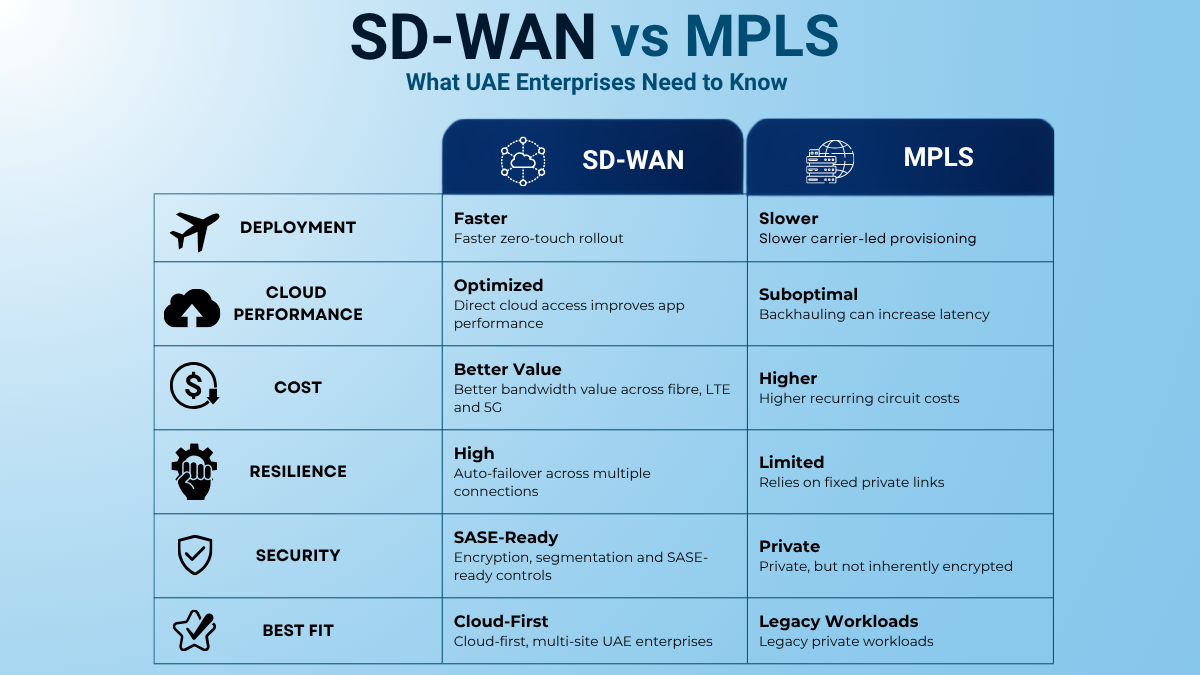
Choosing the right architecture requires a clear-eyed assessment of speed, security, and financial agility. For years, Multiprotocol Label Switching (MPLS) was the gold standard for reliable enterprise connectivity in the Gulf. However, the rise of distributed cloud environments has shifted the requirements. When evaluating SD-WAN solutions UAE leaders must decide whether to maintain the status quo or embrace a more flexible, software-defined future. This decision often hinges on the trade-off between the perceived "safety" of private circuits and the proven resilience of intelligent overlays.
Deployment speed remains one of the most visible differentiators. In the UAE market, provisioning a new MPLS link through local carriers often involves physical infrastructure hurdles that can delay site activation for months. Conversely, SD-WAN enables rapid deployment in a matter of days. By using zero-touch provisioning and transport-agnostic hardware, your team can bring a new branch in Abu Dhabi or a logistics hub in Jebel Ali online almost immediately. This speed allows your business to respond to market opportunities with precision, confidence, and speed.
Security models also differ fundamentally. While MPLS relies on the "privacy" of the carrier's network, it typically lacks inherent encryption for data in transit. Modern SD-WAN integrates Secure Access Service Edge (SASE) principles, providing end-to-end AES 256-bit encryption and integrated firewalling at every edge. Many UAE firms now adopt a hybrid model, retaining MPLS for sensitive, on-premise legacy databases while offloading high-bandwidth cloud traffic to secure SD-WAN tunnels. This "best of both" approach provides a controlled transition path toward full network modernisation.
Performance and Latency Metrics
Network quality is measured by more than just raw speed; it depends on the mitigation of packet loss, latency, and jitter. SD-WAN uses real-time path monitoring to steer traffic away from degraded links, ensuring that critical applications remain stable. This is particularly effective in the UAE, where local internet peering and high-quality fibre backbones provide an excellent foundation for software-defined overlays. While a single MPLS circuit typically offers 99.9% availability, a multi-link SD-WAN configuration can achieve 99.999% potential uptime by leveraging diverse transport paths simultaneously.
Financial Impact and ROI
The shift from traditional networking to software-defined models facilitates a move from CapEx-heavy hardware investments to OpEx-friendly managed service models. This transition allows for better cash flow management and more predictable monthly expenditures. By calculating the "Cost per Mbps," enterprises often find that public broadband and 5G links provide significantly more capacity for a fraction of the price of dedicated private lines. The true ROI, however, is found in the reduction of network-related downtime, which directly improves enterprise productivity and safeguards your digital reputation.
Strategic Implementation: Security, Compliance, and Data Sovereignty
In the UAE, network security is inextricably linked to national compliance standards. As enterprises transition toward SD-WAN solutions UAE providers must ensure that the underlying architecture aligns with the National Electronic Security Authority (NESA) standards. This alignment is not merely a technical requirement; it is a strategic mandate to protect, comply, and scale within a highly regulated environment. A security-first approach ensures that your wide area network does not become a vulnerability but rather a fortified extension of your corporate perimeter.
The convergence of networking and security is most evident in the Secure Access Service Edge (SASE) framework. By integrating Zero Trust principles directly into the fabric of the network, organisations can verify every user, device, and application before granting access. This methodical approach eliminates the traditional "implicit trust" model that often leads to lateral movement during a breach. For UAE enterprises handling sensitive government or financial data, this transition provides the peace of mind that comes from knowing your infrastructure is resilient against modern cyber threats.
Navigating UAE Data Sovereignty
Data residency remains a top priority for regional decision-makers. Modern software-defined networking allows for granular control over exactly where data is routed, processed, and stored. This ensures that cloud traffic for mission-critical applications stays within UAE-based data centres when required by law. For multi-national firms operating across the GCC, this capability allows for the creation of regional policies that respect local regulations while maintaining global connectivity. We ensure your architecture remains compliant with all local data sovereignty requirements while optimising for performance.
Advanced Threat Protection at the Edge
Securing the network edge requires more than just basic encryption. By implementing Next-Generation Firewalls (NGFW) within the SD-WAN appliance, businesses can inspect traffic in real-time to identify and block malicious activity. This centralised management allows IT leaders to push security patches and policy updates across all national nodes simultaneously, ensuring a consistent security posture. This model provides a single point of accountability, reducing the friction often found when managing disparate security tools. To ensure your infrastructure meets these rigorous standards, you can request a comprehensive security and networking audit from our expert team.
Architecting Your Future: The Live in the Cloud ME Approach
Selecting the right infrastructure is a decision that defines your organisation's operational trajectory for years to come. While many providers in the region act as simple resellers or carriers pushing proprietary, locked-in lines, we offer a vendor-neutral advisory service. This independence ensures that your technology stack is built around your specific business goals rather than a provider's quarterly quota. By acting as a trusted technology partner, we empower our partners to modernise their infrastructure, secure their edges, and optimise their application performance with absolute clarity.
Our methodology relies on the weight of experience and the strength of our global partnerships. We collaborate with industry leaders like Cisco and Fortinet to deliver SD-WAN solutions UAE enterprises need to maintain a competitive advantage. This consulting-led approach ensures that every deployment is tailored to the unique geographical and regulatory requirements of the GCC. Beyond the initial implementation, our managed services provide the ongoing oversight and operational support necessary to manage increasingly complex technology environments, allowing your internal teams to focus on core business growth.
A Single Point of Accountability
Complexity is the enemy of efficiency. We simplify your environment by providing a single point of accountability that spans strategic advisory, project delivery, and licensing procurement. This holistic oversight reduces the friction often caused by fragmented technology stacks and multiple vendor relationships. Our team takes full responsibility for the environments we manage, ensuring that your IT infrastructure is perfectly aligned with your long-term business objectives. We don't just deliver a service; we build a partnership based on accountability, reliability, and tangible value.
Getting Started with Your Network Modernisation
A successful transition begins with a deep understanding of your current environment. We recommend a comprehensive network audit and readiness assessment to identify existing bottlenecks and security gaps. This process allows us to define clear KPIs for your migration, ensuring that the project delivers measurable improvements in latency, uptime, and cost efficiency. If you're ready to move beyond the limitations of legacy infrastructure, you can contact our expert team to modernise your enterprise networking and secure a resilient foundation for your digital future.
Building a Resilient Network Backbone
Modernising your enterprise connectivity is a journey that transforms the network from a cost centre into a strategic asset. We've examined how shifting toward software-defined architectures eliminates the rigidity of legacy circuits while enhancing performance for mission-critical cloud applications. By prioritising NESA-compliant security frameworks and ensuring data sovereignty, your organisation can scale with absolute confidence in an increasingly cloud-centric world.
Implementing the high-performance SD-WAN solutions UAE leaders require is about more than just bandwidth; it's about stability, security, and strategic foresight. Our team brings a vendor-neutral advisory approach, combining deep expertise in Cisco and Fortinet with a commitment to regional excellence. We provide a single point of accountability to ensure your digital transformation remains on track, providing a stabilising force in a complex technical landscape. Your path to a more agile and secure network starts with a partner who understands the local landscape and global standards. Consult with our Strategic Architects to optimise your UAE network and build the foundation your business deserves.
Planning a network refresh, branch expansion, cloud connectivity project or SD-WAN deployment?
Contact LITC for an assessment of your current network architecture and recommendations tailored to your business.
Frequently Asked Questions (FAQ)
What is the primary difference between SD-WAN and MPLS for UAE businesses?
The primary difference lies in the architecture: MPLS is a rigid, carrier-dependent hardware circuit, whereas SD-WAN is an intelligent software overlay. While MPLS provides dedicated paths, it lacks the agility and cost-efficiency required for cloud-centric operations. SD-WAN allows you to manage, secure, and optimise traffic across multiple transport types, including public internet and 5G, from a single centralised controller.
Is SD-WAN secure enough for financial or government sectors in the UAE?
Yes, modern SD-WAN solutions UAE enterprises deploy are built on Secure Access Service Edge (SASE) principles. These systems provide end-to-end AES 256-bit encryption, integrated next-generation firewalls, and Zero Trust access controls. This methodical approach ensures that sensitive data remains protected, making it a robust choice for the rigorous security demands of the financial and government sectors.
How does SD-WAN improve the performance of Microsoft 365 and Azure?
Performance improves because SD-WAN enables direct internet breakout for cloud traffic, bypassing the latency caused by traditional data centre backhauling. By identifying application-specific traffic, the system prioritises Microsoft 365 and Azure data over generic web browsing. This ensures that users experience faster response times, reduced jitter, and more reliable connections to critical cloud-native business tools.
Can we use our existing internet service providers with a new SD-WAN solution?
You can absolutely use your existing internet service providers with a new SD-WAN solution. The technology is transport-agnostic, meaning it works seamlessly with any combination of fibre, LTE, or 5G links from local carriers like Etisalat (e&) or du. This flexibility allows you to aggregate multiple connections to increase total bandwidth, improve resilience, and ensure continuous uptime without changing your current providers.
What are the typical cost savings when moving to SD-WAN in the UAE?
Organisations that transition from traditional MPLS to software-defined networking can save between 50% and 84% on their total WAN costs. These savings are achieved by offloading non-critical traffic to more affordable public internet links and reducing the need for expensive, proprietary hardware. This shift allows IT leaders to reallocate budgets toward strategic growth, cybersecurity, and digital transformation initiatives.
Does SD-WAN help with NESA compliance and UAE data sovereignty?
SD-WAN directly supports NESA compliance by providing granular visibility and control over all network traffic. It allows administrators to enforce strict data sovereignty policies, ensuring that sensitive data remains within UAE-based data centres as required by law. By integrating automated policy enforcement and encryption, the system helps you maintain, document, and prove compliance with national electronic security standards.
How long does a typical SD-WAN implementation take for a nationwide firm?
A typical SD-WAN implementation for a nationwide firm can be completed in a matter of days once the hardware is on-site. This is a significant improvement over the months often required to provision new MPLS circuits. Through zero-touch provisioning, our architects can deploy, configure, and secure new branch locations remotely, ensuring that your connectivity scales at the speed of your business requirements.
What happens if our primary internet link fails in an SD-WAN setup?
If your primary internet link fails, the SD-WAN appliance performs a sub-second failover to an available secondary or backup link. This transition is so rapid that active sessions, such as VoIP calls or database connections, don't drop. The system continuously monitors, assesses, and reacts to link quality, ensuring that your enterprise connectivity remains stable, resilient, and high-performing even during a transport failure.