
The Enterprise Guide to Managed IT Services in the UAE (2026)
As a business leader in the UAE, you depend on technology to operate efficiently, serve customers, and grow. But managing that technology is becoming increasingly complex. Your in-house IT team is likely stretched thin, dealing with everything from daily support tickets to the growing threat of cyberattacks and the constant pressure to innovate.
Table of Contents
Why Outsourced IT Management is a Necessity for UAE Businesses in 2026
In the past, IT support was about fixing problems as they occurred. Today, a modern managed IT service is a partnership focused on preventing those problems from happening in the first place. It provides a single point of accountability for keeping your business secure, compliant, and running without interruption.
For many UAE businesses, the old model of relying solely on an in-house team is no longer sustainable. Here’s why:
- The Technology Overload: The pace of change is relentless. Managing cloud platforms like Microsoft Azure or AWS, securing Microsoft 365, and defending against sophisticated cyber threats requires specialised skills that are expensive and difficult to find in-house.
- Predictable Costs: Hiring, training, and retaining a full team of IT specialists creates unpredictable, high capital expenditure (CapEx). Managed services shift this to a predictable monthly operational expense (OpEx), making budgeting far simpler.
- Focus on Your Core Business: Every hour your team spends on routine IT maintenance is an hour not spent on projects that drive revenue. Outsourcing allows your key people to focus on innovation and growth.
The UAE Regulatory Landscape: PDPL, NESA, and Data Sovereignty
Operating in the UAE means navigating a strict and evolving set of rules for data protection and security. The UAE's Personal Data Protection Law (PDPL) and the National Electronic Security Authority (NESA) standards are not optional. They dictate how you must handle, store, and protect sensitive data.
A key requirement is data sovereignty - the mandate that certain types of data must remain physically within the country's borders. This has significant implications for businesses using global cloud services.
An experienced local managed service provider (MSP) helps you:
- Ensure Compliance: They design and manage IT systems that meet PDPL and NESA requirements from the ground up, often using in-country data centres.
- Avoid Penalties: Non-compliance can result in significant fines and reputational damage. An MSP acts as your compliance partner, reducing this risk.
- Meet Sector-Specific Rules: Industries like finance, healthcare, and government have additional, even stricter regulations. A knowledgeable partner understands these nuances and builds solutions to match.
Bridging the Talent Gap in the GCC
Finding and affording top-tier talent in specialised fields like cybersecurity, cloud architecture, and AI is a major challenge for businesses across the GCC. The demand far outstrips the local supply, leading to high salaries and fierce competition for qualified experts.
Partnering with an MSP gives you immediate access to a deep bench of certified professionals without the overhead of direct employment. This allows you to:
- Access Specialised Expertise: Instantly gain the knowledge of certified experts in Microsoft Azure, AWS, Cisco networking, and advanced cybersecurity.
- Reduce HR Costs: Avoid the high costs and long timelines associated with recruiting, hiring, and retaining a large internal IT team.
Empower Your Internal Team: Free your existing IT staff from day-to-day firefighting so they can concentrate on strategic initiatives that directly support your business objectives.
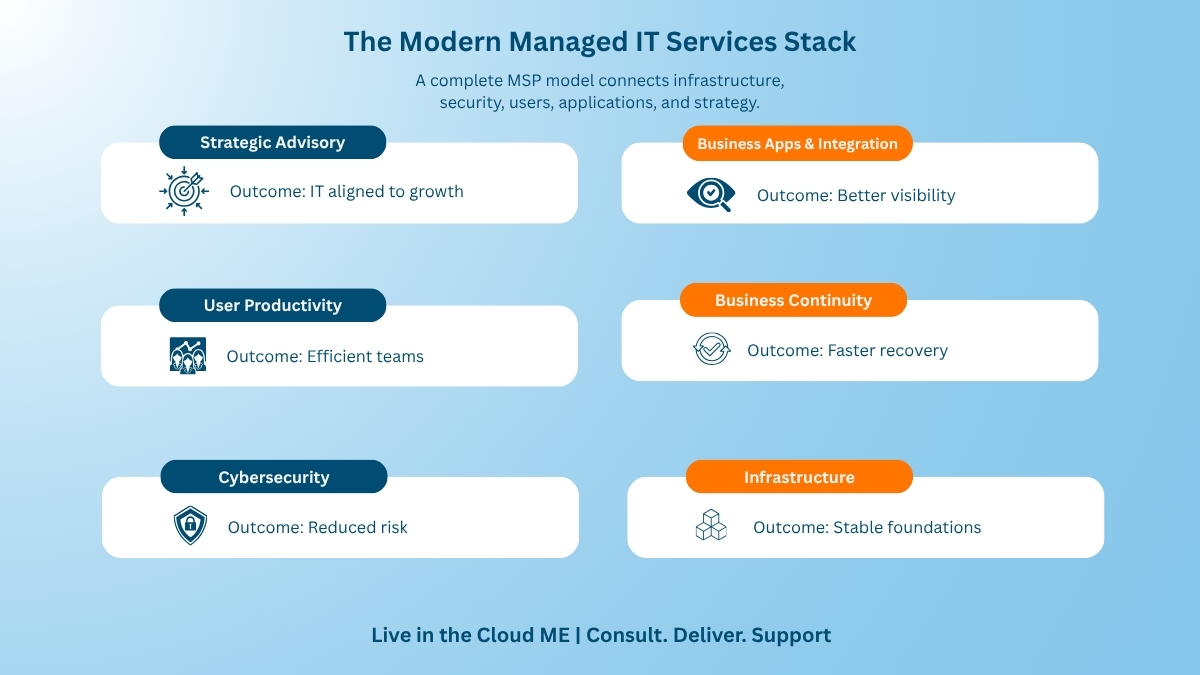
The Modern Managed Services Stack: From Infrastructure to Applications
|
Service Layer
|
What It Includes
|
Business Outcome
|
|
Infrastructure
|
Management of cloud (Azure, AWS), on-premise servers, and hybrid environments.
|
A stable, scalable, and cost-effective foundation for your business.
|
|
Security
|
24/7 monitoring (SOC), firewall management, endpoint protection, vulnerability scanning.
|
Protection against cyber threats, data breaches, and business disruption.
|
|
Business Continuity
|
Automated data backup, disaster recovery planning, and regular testing.
|
The ability to recover quickly from any incident, from hardware failure to a cyberattack.
|
|
User Productivity
|
Microsoft 365 management, helpdesk support, and application integration.
|
An empowered, efficient workforce with reliable access to their tools.
|
Infrastructure
What it Includes Management of cloud (Azure, AWS), on-premise servers, and hybrid environments.
Business Outcome A stable, scalable, and cost-effective foundation for your business.
Security
What it Includes 24/7 monitoring (SOC), firewall management, endpoint protection, and vulnerability scanning.
Business Outcome Protection against cyber threats, data breaches, and business disruption.
Business Continuity
What it Includes Automated backup, disaster recovery planning, and regular testing.
Business Outcome The ability to recover quickly from any incident.
User Productivity
What it Includes Microsoft 365 management, helpdesk support, and application integration.
Business Outcome An empowered, efficient workforce with reliable access to their tools.
Cloud and Hybrid Environments
Many UAE businesses have a mix of technology: some servers on-premise, some applications in the cloud. This "hybrid" model offers flexibility but can be complex to manage. An MSP helps you get it right.
Key activities include:
- Cloud Migration Planning: Carefully moving applications and data from your local servers to a cloud platform like Azure or AWS, ensuring minimal disruption.
- Cost Optimisation: Actively managing your cloud usage to prevent "cloud sprawl"—the uncontrolled rise in monthly bills. This involves right-sizing resources and turning off systems that aren't in use.
- System Integration: Ensuring your on-premise and cloud systems communicate seamlessly, providing a unified and efficient experience for your users.
Cybersecurity: A Proactive Defense
In today's environment, waiting to react to a cyberattack is a losing strategy. A modern managed security service (MSSP) focuses on proactive, 24/7 defense. This is a significant step up from traditional antivirus software.
This managed defense model includes:
- Security Operations Center (SOC): A dedicated team of security analysts monitoring your network around the clock, looking for and responding to threats in real-time.
- Zero Trust Principles: Implementing a modern security approach where no user or device is trusted by default. This dramatically reduces the risk of unauthorised access.
- Continuous Management: Regularly scanning for vulnerabilities, applying security patches to servers and software, and managing firewalls to keep your defenses up to date.
Practical Guidance for AI and Business Applications
Artificial Intelligence (AI) is no longer a futuristic concept; it's a practical tool that can enhance business operations. However, adopting it requires careful planning. You can't simply "turn on" AI and expect results.
An MSP with advisory capabilities can provide practical guidance:
- Data Readiness: Helping you organise and clean your company data so it's ready to be used by AI tools. Poor data quality is the biggest barrier to successful AI implementation.
- Tool Selection: Evaluating which AI-powered tools, such as Microsoft Copilot for 365, will deliver a real return on investment for your specific business processes.
System Modernisation: Integrating modern applications (like ERP and CRM systems) to eliminate data silos and create the unified data environment that AI relies on.
Consulting-Led vs. Traditional IT Support: The Vendor-Neutral Advantage
There is a fundamental difference between a traditional IT support company and a consulting-led managed services partner.
A traditional provider often focuses on selling specific products - usually the ones that earn them the highest commission. This can lead to "vendor lock-in," where you are stuck with technology that isn't the best fit for your business simply because your provider prefers it.
A vendor-neutral, consulting-led partner operates differently. Their primary goal is to understand your business objectives first and then recommend the technology that best achieves them. They are not tied to a single brand. Whether the right solution is Microsoft Azure, AWS, or a specific firewall from Cisco or Fortinet, their advice is based on your needs, not their sales targets.
This approach gives you a single point of accountability, even in a complex environment with multiple technology vendors. Instead of you managing relationships with Microsoft, your internet provider, and various software companies, your MSP handles it all.
How a Consulting-Led Approach Works
This model is built on a long-term, strategic relationship rather than short-term fixes.
- Discovery and Planning: The engagement begins with a thorough assessment of your current IT environment and a deep dive into your 3-5 year business goals. The technology roadmap is then built to support those goals.
- Cost Optimisation: A good partner will analyse your software licensing and procurement, often finding significant cost savings by negotiating with vendors on your behalf and eliminating redundant services.
- Regular Strategic Reviews: Technology and business needs change. A consulting-led partner provides regular reviews (often called vCIO, or Virtual Chief Information Officer, services) to ensure your IT strategy remains aligned with your evolving business.
Unifying Your Technology
Most businesses suffer from "data silos" - critical information trapped in separate, disconnected systems (e.g., your accounting software doesn't talk to your sales CRM). This creates inefficiency and prevents you from getting a clear view of your operations.
A key role of a managed services partner is to act as a system integrator, unifying these disparate systems. By managing application integration and standardising your network and security infrastructure, they create a "single pane of glass" view of your IT, making it simpler to manage and more valuable to the business.
Selecting the Right Partner: A 5-Step Evaluation Framework
Choosing a managed IT services provider is a critical decision. The right partner will be a catalyst for growth, while the wrong one can create risk and frustration. Use this practical framework to evaluate potential partners in the UAE.
- Verify Regional Compliance and Data Residency: Ask direct questions. "Where will our data be stored?" "Can you demonstrate how your solutions comply with UAE PDPL and NESA standards?" Request to see relevant certifications (like ISO 27001) and proof of in-country data centre capabilities.
- Assess Technical Depth and Certifications: Don't just take their word for it. Ask about the specific certifications their engineers hold for key technologies like Microsoft Azure, AWS, Cisco, and Fortinet. A deep technical team is a sign of a mature and capable provider.
- Scrutinise the Service Level Agreement (SLA): Look beyond simple response times. A strong SLA should include guarantees for uptime and proactive monitoring. It should clearly define what is covered in the monthly fee versus what is considered a separate project with additional costs.
- Confirm a Vendor-Neutral Stance: Ask them to describe a situation where they recommended a solution from a vendor other than their primary partner. Their answer will reveal whether they are truly objective or just a reseller for a specific brand.
- Look for Strategic Business Acumen: Does the conversation feel purely technical, or are they asking questions about your business goals, challenges, and growth plans? A true partner talks about business outcomes, not just technology speeds and feeds.
Red Flags in UAE Managed Service Contracts
As you evaluate providers, watch out for these common warning signs:
- Vague "All-Inclusive" Pricing: Be wary of contracts that seem too good to be true. Often, "all-inclusive" support excludes critical activities like new user onboarding, office moves, or project work, leading to unexpected bills.
- Lack of Local Data Centre Options: If a provider cannot clearly state that they can host your data within the UAE, they may not be able to meet local data sovereignty requirements.
- Focus on Headcount, Not Outcomes: If a provider's main selling point is the number of engineers they have ("a body shop"), they may be focused on reactive ticket-closing rather than proactive, strategic management.
The Importance of Regional Experience
Choosing a partner with deep roots and a physical presence in the UAE and the wider GCC region is crucial. A local partner understands the nuances of the market, from navigating logistics and supply chains to respecting local business etiquette. They have a proven track record of helping businesses like yours succeed in this unique economic environment.
Live in the Cloud ME: Your Partner for IT Clarity and Control
For over 15 years globally and 6 years in the GCC, Live in the Cloud ME has helped businesses modernise, secure, and optimise their IT environments. We are a technology consultancy and Managed Service Provider that believes in a consulting-first approach.
Our process always starts with a conversation about your business goals, not with a quote for hardware. We act as a single point of accountability for your entire technology landscape.
- Consulting-First Philosophy: We build a technology strategy that aligns with your business plan before we manage a single server. Our goal is to provide clarity and a predictable path forward.
- Our Vendor-Neutral Promise: We partner with world-class technology leaders like Microsoft, AWS, Google Cloud, and Cisco, but our loyalty is to you. We recommend the solution that is right for your objective and your budget.
- A Single Point of Accountability: We simplify your operations by managing your cloud infrastructure, cybersecurity, business applications, and vendor relationships, giving you one expert team to call for any IT need.
Our Core Managed Service Offerings
We provide a comprehensive suite of services designed to support your business at every stage of its growth:
- Managed Cloud and IT Infrastructure: End-to-end management of your cloud platforms, hybrid environments, and networking to ensure stability and control costs.
- Cybersecurity and Business Continuity: Comprehensive security frameworks, 24/7 monitoring, and robust disaster recovery solutions to protect your business from threats and downtime.
- Strategic Technology Advisory: Practical guidance on technology procurement, system integration, and adopting new tools like AI to give you a competitive edge.
Take the Next Step in Your IT Modernisation
Moving to a managed services model should improve your business, not disrupt it. Our onboarding process is designed to be seamless, secure, and efficient, ensuring a smooth transition.
If you are ready to gain control over your IT and align your technology with your business ambitions, we invite you to start a conversation.