The Business Landscape Is Changing Faster Than Ever
Across the UAE and the wider GCC, the mandate is clear: build a digital‑first economy whilst safeguarding resilience. The UAE Digital Economy Strategy aims to double the digital economy’s share of GDP from 9.7% (2022) to 19.4% within 10 years – a strong signal that technology will drive growth across every sector. In parallel, Dubai’s updated Cyber Security Strategy (2023) emphasises a cyber‑secure society, resilient infrastructure, and innovation – so organisations can modernise confidently.
At Live in the Cloud ME, we help leaders navigate this shift without vendor lock-in, aligning business outcomes to practical, secure IT roadmaps spanning digital transformation, AI, automation, and resilience. We deliver end-to-end solutions as a Value-Added Reseller (VAR), Managed Service Provider (MSP), and Systems Integrator.
Operational Inefficiencies → Automate, integrate, and visualise end‑to‑end
What we see: Manual hand‑offs, swivel‑chair work, siloed data, slow decisions and inflated costs.
Proof in action:
- Emirates NBD used process automation to handle over 95% of service requests digitally, cutting response times and freeing up staff for advisory roles. (Emirates NBD)
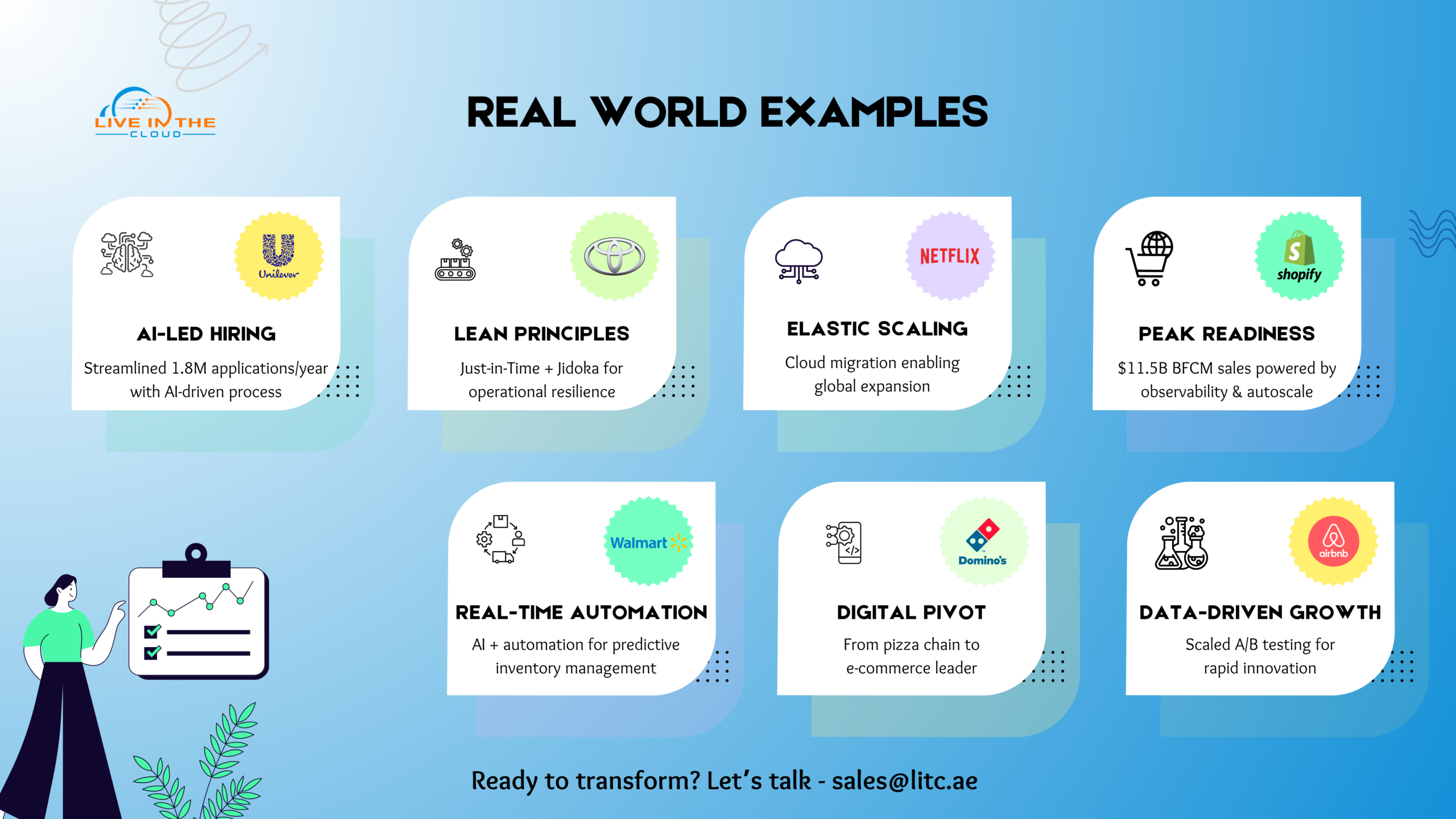
- Unilever streamlined high-volume hiring with an AI-led process to handle 1.8 million applications per year, improving efficiency and fairness. (Forbes)
- NHS (UK) reduced patient admin time by 400,000 hours using low-code automation to connect legacy systems and deliver faster decisions. (Microsoft UK, Low-Code in the NHS Guide, Microsoft Industry Blog)
- Walmart scaled real-time automation across supply chains in multiple regions, turning signals into immediate action and improving inventory accuracy. (Walmart Corporate, SupplyChainBrain)
How LITC helps:
- We analyse and streamline critical workflows to identify where automation and integration create the greatest impact.
- We connect disconnected systems through secure, scalable ERP, CRM, and BPM integrations without vendor lock-in.
- We deploy low-code automation to reduce manual effort, improve data visibility, and accelerate decision-making.
- We deliver unified, near real-time BI dashboards so leaders can monitor performance, identify bottlenecks, and act faster.
What to do next: Identify your top three manual or disconnected processes, deliver two automation wins in 60–90 days, and unify insights through connected BI and ERP integration.
Cybersecurity Threats → Zero Trust + resilience by design
What we see: Threat actors exploit misconfigurations and flat networks; one incident can trigger multi‑day outages.
Proof in action:
- Maersk’s 2017 NotPetya incident brought global systems down within hours; recovery depended on segmentation, tested backups, and Active Directory rebuilds. A resilience-by-design lesson for every organisation, regardless of industry. (Columbia SIPA Case Study, CSO Online)
- The UAE Cybersecurity Council continues to drive national resilience through the UAE Cyber Pulse and awareness programs, ensuring readiness across both public and private sectors. (GCC Security Symposium)
- Capital One’s full migration to a secure cloud environment showed how strong governance and Zero Trust principles enable agility without compromising compliance. (Capital One Blog)
- Healthcare and education providers in the GCC are now adopting Zero Trust and BCDR frameworks to secure hybrid work and protect sensitive data as digital transformation accelerates. (GCC Security Symposium, UAE Budget for AI & Healthcare)
How LITC helps:
- We design and implement Zero Trust frameworks to secure access, data, and applications across hybrid and remote environments.
- We develop business continuity and disaster recovery strategies, including tested restore and recovery processes, to ensure operational resilience.
- We assess and segment critical systems to reduce risk exposure while maintaining visibility and control.
- We integrate monitoring, governance, and alerting into existing technology environments, so security and compliance are maintained without unnecessary complexity.
What to do next: Strengthen identity protection with multi-factor authentication and least-privilege access, segment critical systems, and regularly test recovery plans to validate resilience.
Talent Shortages & Workforce Challenges → Tech‑enabled talent models
What we see: Scarce skills and hybrid work expectations strain delivery.
Proof in Action:
- Amazon – Career Choice Programme: Amazon invests heavily in upskilling and reskilling through its Career Choice programme, funding training for employees to move into high-demand roles like IT and healthcare. The programme leverages digital learning platforms, AI-driven skills assessments, and virtual labs to personalise learning and track progress. This approach helps retain talent, accelerate skill development, and future-proof the workforce. (Amazon Career Choice)
- Global IT and healthcare organisations are using AI-driven workforce analytics and predictive modelling to identify skill gaps, optimise training programmes, and ensure teams remain agile as workloads evolve. (Microsoft AI in Workforce Planning)
- Government and education sectors in the GCC are adopting hybrid work models supported by secure collaboration platforms, workflow automation, and digital learning tools to overcome staffing shortages and improve productivity. (UAE Emerges as Remote Work Leader in GCC, UAE Approves Remote Work System for Federal Employees Abroad)
How LITC helps:
- We modernise architectures using domain-driven design, APIs, and event-driven systems to improve scalability and flexibility.
- We implement performance engineering practices, including load testing, capacity modelling, and establishing measurable service-level objectives.
- We enable full-stack observability, integrating metrics, logs, and traces across heterogeneous systems to ensure visibility, predictability, and faster incident response.
What to do next: Design for spiky demand with auto-scaling, caching, and stateless services; perform continuous load testing; and deploy end-to-end observability to maintain quality as you grow.
What we see: Scarce skills and hybrid work expectations strain delivery.
Proof in Action:
- Amazon – Career Choice Programme: Amazon invests heavily in upskilling and reskilling through its Career Choice programme, funding training for employees to move into high-demand roles like IT and healthcare. The programme leverages digital learning platforms, AI-driven skills assessments, and virtual labs to personalise learning and track progress. This approach helps retain talent, accelerate skill development, and future-proof the workforce. (Amazon Career Choice)
- Global IT and healthcare organisations are using AI-driven workforce analytics and predictive modelling to identify skill gaps, optimise training programmes, and ensure teams remain agile as workloads evolve. (Microsoft AI in Workforce Planning)
- Government and education sectors in the GCC are adopting hybrid work models supported by secure collaboration platforms, workflow automation, and digital learning tools to overcome staffing shortages and improve productivity. (UAE Emerges as Remote Work Leader in GCC, UAE Approves Remote Work System for Federal Employees Abroad)
How LITC helps:
- We modernise architectures using domain-driven design, APIs, and event-driven systems to improve scalability and flexibility.
- We implement performance engineering practices, including load testing, capacity modelling, and establishing measurable service-level objectives.
- We enable full-stack observability, integrating metrics, logs, and traces across heterogeneous systems to ensure visibility, predictability, and faster incident response.
What to do next: Design for spiky demand with auto-scaling, caching, and stateless services; perform continuous load testing; and deploy end-to-end observability to maintain quality as you grow.
Scaling Without Losing Quality → Elastic, observable architectures
What we see: Rapid growth exposes bottlenecks in monoliths and brittle infrastructure, slowing innovation and impacting customer experience.
Proof in action:
- Netflix completed its cloud migration in 2016, enabling on-demand elasticity and rapid global expansion to 130+ countries. By leveraging microservices, APIs, and automated scaling, the platform maintained high performance and reliability even under massive load. (About Netflix)
- Shopify handled $11.5B in Black Friday Cyber Monday 2024 weekend sales, peaking at $4.6M/min. Their platform uses real-time observability, auto-scaling, and event-driven architecture to maintain stability while processing trillions of requests. (Shopify News)
- Global e-commerce and logistics companies are adopting cloud-native architectures, monitoring dashboards, and automated scaling to meet fluctuating demand while maintaining quality and reliability. (Gartner)
How LITC helps:
- Architecture modernisation (not just lift and shift): domain‑driven design, APIs, event streams.
- Performance engineering: load testing, capacity modelling, SLOs and error budgets.
- Full‑stack observability: tracing, metrics, logs unified across heterogeneous estates.
What to do next: Design for spiky demand (auto scale, caching, stateless services), load‑test continuously, and deploy end‑to‑end observability.
Adapting to Fast‑Moving Markets → Data‑driven, product‑led growth
What we see: Winners compress the learn–build–measure cycle and personalise experiences to capture market opportunities faster than competitors.
Proof in action:
- Domino’s transformed from a “pizza company” into a digital-first e-commerce leader. Technology such as self-serve ordering platforms, customer analytics, and AI-driven recommendations enabled rapid experimentation and improved customer experiences.(Forbes)
- Airbnb industrialised experimentation, e.g., interleaving for search ranking and scaled A/B platforms to speed learning cycles. (Airbnb Engineering Blog)
- Regional e-commerce and service providers are adopting data pipelines, self-serve dashboards, and predictive analytics to test new ideas quickly, reduce risk, and respond to customer trends. (The Finance World)
How LITC helps:
- Data productisation: We transform source systems into governed, query-ready datasets and self-serve BI, making insights accessible to decision-makers.
- Experimentation frameworks: We help clients embed feature flags, cohorting, and telemetry into workflows so new ideas can be tested and validated rapidly.
- Predictive analytics: We turn operational data into actionable insights for maintenance, quality, supply chain, or customer experience improvements.
What to do next: Productise your data today through BI, embed experimentation rituals, and link features or process changes to measurable outcomes. Over time, layer predictive analytics to anticipate trends and respond proactively.
A Vendor-Agnostic 90-Day Playbook: How LITC Typically Executes
Prioritise outcomes:
Identify the top three transformation priorities (e.g., higher NPS, lower cost-to-serve, faster lead-to-cash) and map the minimum viable technology and process improvements required to achieve each.
Secure foundations first:
Implement Zero Trust and resilience quick wins, such as identity hygiene, multi-factor authentication, segmentation, and tested restore procedures to protect operations from day one.
Deliver rapid automation wins:
Execute 2–3 low-code or workflow automation sprints to optimise critical processes, then integrate them with ERP, BPM, or collaboration tools for real-time visibility and reporting.
Build for scalability and observability:
Design systems and processes to handle peak demand with auto-scaling, caching, and stateless workflows, while monitoring performance and KPIs continuously to ensure quality and resilience.
Embed experimentation and insight loops:
Establish simple frameworks to test ideas, gather data, and iterate quickly. Turn operational and business data into actionable insights that drive measurable outcomes.
Outcome:
In 90 days, organisations have a practical, resilient, and scalable foundation, quick wins in automation and efficiency, and a roadmap for ongoing transformation without vendor lock-in.
Ready to Turn Challenges into Competitive Advantage?
Five common business challenges. One IT-driven approach to solve them all.
See how Live in the Cloud ME helps leaders streamline processes, secure operations, and unlock growth - all without vendor lock-in.